
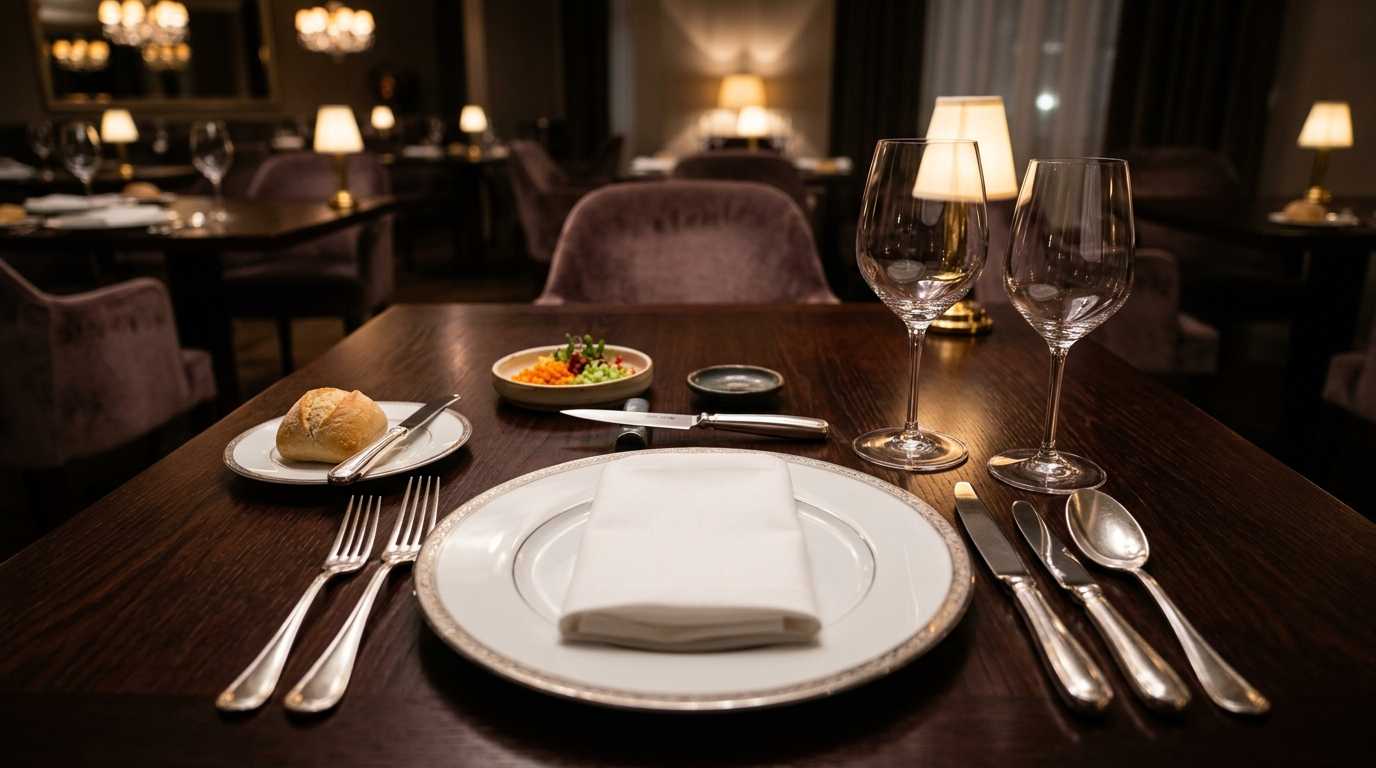

Fine dining begins long before the first course reaches the table. The experience depends on a combination of precise culinary preparation, disciplined knife skills, thoughtful presentation, and formal table etiquette. When these elements work together, every detail—from the size of a vegetable dice to the placement of a dessert spoon—supports the rhythm of the meal.
For anyone preparing for a formal dinner, culinary event, hospitality setting, or elevated home dining experience, understanding these fundamentals creates confidence. We can approach the table with greater ease when we understand why utensils appear in a particular order, how courses progress, and how precision preparation influences the appearance and texture of food.
Table of Contents
Understanding Precision Knife Skills in Fine Dining
Professional kitchens rely on consistency. A beautifully plated dish can lose much of its refinement when vegetables are cut unevenly, proteins are sliced inconsistently, or garnishes lack precision.
Knife skills therefore form one of the foundations of fine dining preparation. We aim for cuts that are uniform in size, shape, and thickness, allowing ingredients to cook evenly and appear deliberate on the plate.
Several classic culinary cuts appear repeatedly in refined cooking.
Julienne Cut
Julienne produces thin, matchstick-shaped pieces. Vegetables such as carrots, zucchini, celery, and bell peppers can be prepared this way for garnishes, salads, soups, and composed plates.
Consistency matters more than simply producing thin strips. When each piece is approximately the same size, cooking becomes more predictable and the finished dish looks considerably more polished.
Brunoise Cut
Brunoise is a very fine dice traditionally produced from julienne-cut vegetables. The resulting cubes are small and uniform, making the technique useful for sauces, garnishes, fillings, and finely textured preparations.
A precise brunoise demonstrates control. In a refined dish, those tiny cubes can contribute both visual detail and subtle texture without overwhelming the principal ingredient.
Tourné Cut
The tourné is one of the more recognizable classical French cuts. Vegetables are shaped into small, elongated forms with multiple curved surfaces.
This technique requires patience because the objective is not merely to remove excess vegetable material. We create a consistent decorative shape that cooks evenly and presents neatly alongside the main component.
Chiffonade
Chiffonade involves cutting leafy ingredients into fine ribbons. Basil, spinach, mint, and other tender leaves can be prepared using this technique.
The finished ribbons can provide fragrance, color, and visual movement without making the garnish appear heavy.
Knife Control and Safe Cutting Technique
Precision begins with control rather than speed. We should never attempt to reproduce professional kitchen speed before developing reliable technique.
A stable cutting board is essential. A damp kitchen towel placed underneath the board can help reduce movement. We should also keep the knife properly sharpened because a dull blade often requires excessive pressure and can become more difficult to control.
The non-cutting hand should generally use a claw position, with fingertips curled inward and the knuckles helping guide the blade. This protects the fingertips while creating a consistent cutting reference.
The knife should remain controlled throughout the movement. Rather than forcing the blade straight downward for every cut, we can use the appropriate rocking, slicing, or chopping motion according to the ingredient and technique.
Good knife skills are ultimately about repeatability. The goal is to produce the same cut repeatedly, not simply to produce one attractive piece.
Why Precision Cuts Matter on a Fine Dining Plate
Precision preparation affects more than appearance. Uniform cuts influence cooking time, texture, seasoning, and the balance of ingredients within each bite.
Suppose we prepare a vegetable garnish containing pieces of dramatically different sizes. Smaller pieces may become soft while larger pieces remain firm. The result can feel inconsistent even if the ingredients themselves are excellent.
When cuts are uniform, each component can reach the intended texture more predictably. This gives chefs greater control over the final plate.
Presentation also benefits. Fine dining relies heavily on visual composition, and carefully cut ingredients naturally create cleaner lines, more balanced shapes, and more intentional arrangements.
Formal Table Setting Dimensions and Cutlery Placement
Once preparation is complete, attention turns to the dining table.
A formal table setting should feel organized rather than crowded. Each piece of cutlery has a purpose, and its position helps communicate the progression of the meal.
The dinner plate normally provides the central reference point. Forks are traditionally positioned to the left, while knives and spoons are placed to the right.
The cutting edge of a dinner knife generally faces inward toward the plate. This small detail contributes to the orderly appearance of a formal setting.
When multiple forks, knives, or spoons are required, their placement usually corresponds to the sequence in which they will be used. This means guests can work naturally from the outside toward the plate as the meal progresses.
Navigating Multi-Utensil Settings
A formal setting may initially appear complicated because several utensils can be placed around the plate.
The simplest principle is to remember the outside-in progression.
The utensil positioned farthest from the plate is generally intended for the earliest course associated with that side. As additional courses arrive, we move inward toward the utensils positioned closest to the plate.
For example, a formal dinner may include a salad fork, dinner fork, soup spoon, dinner knife, fish knife, or additional specialty utensils. The exact arrangement varies according to the menu and service style.
Rather than memorizing every possible configuration, we can focus on the relationship between the menu and the utensils.
The table setting should support the meal.
Understanding Cutlery Placement at a Formal Dinner
Forks generally remain on the left side of the place setting, while knives and spoons generally remain on the right.
A soup spoon may be positioned to the right of the knives when soup is part of the menu. A dessert spoon or fork can be positioned above the plate or brought with the appropriate dessert course, depending on the service style.
Specialized cutlery should only appear when it serves a genuine purpose. A formal table is not improved by unnecessary utensils.
The strongest settings are those in which every object feels intentional.
Napkin Placement and Formal Dining Etiquette
The napkin is another important part of formal table etiquette.
Depending on the setting, it may be placed on the plate or to the left of the forks. Once seated, we can place the napkin on the lap rather than immediately leaving it on the table.
When temporarily stepping away, the napkin can be placed neatly on the chair or according to the established etiquette of the setting. At the end of the meal, it should be placed neatly beside the plate rather than left crumpled across the table.
The objective is simple: maintain an orderly environment without drawing unnecessary attention to the mechanics of dining.
How Course Progression Influences Table Settings
A multi-course meal works as a sequence rather than a collection of unrelated dishes.
We may begin with an appetizer, continue to soup or salad, move into a fish or intermediate course, serve the main course, and finish with dessert.
Each course has its own rhythm, and the table setting should accommodate that progression.
Understanding course progression makes formal dining much easier because we can connect the utensils to the food rather than trying to memorize an isolated set of rules.
The same principle applies to beverage service. Different wines may accompany different courses, while water remains available throughout the meal.
Table Etiquette During Multiple Courses
Good table etiquette is largely about awareness.
We should wait until the appropriate moment before beginning a course, maintain a comfortable pace, and avoid rushing ahead of the rest of the table.
Conversation should continue naturally without allowing the meal to become secondary. We should also avoid reaching across other diners when requesting an item. Asking politely for an item to be passed is more appropriate than leaning across the table.
Cutlery should be handled quietly and deliberately. Excessive gestures with utensils, unnecessary movement, and loud contact between cutlery and plates can disrupt an otherwise refined dining environment.
Using Cutlery Correctly Between Bites
During a formal meal, cutlery placement can communicate whether we are temporarily pausing or have completed a course.
When taking a short pause, utensils can be positioned neatly on the plate rather than being left on the tablecloth.
Once a course is finished, the cutlery can be placed together on the plate in the conventional finished position appropriate to the dining style.
The important principle is consistency. We should avoid resting used utensils directly on the table because doing so can create unnecessary mess and confusion for service staff.
Fine Dining Knife Skills and Plate Presentation
Knife skills become particularly important when food is prepared for presentation.
A composed plate may contain several components: a principal protein, vegetable preparation, starch, sauce, garnish, and finishing element. Each component needs to occupy its own visual space without making the plate appear crowded.
Precisely cut vegetables can create clean geometric accents. Thin slices can establish elegant lines, while small dice can add texture and color.
However, precision should never become decoration for its own sake. The cut should serve the ingredient and the dish.
Balancing Texture, Size, and Presentation
An elegant plate usually benefits from variation, but that variation should remain controlled.
We can combine crisp vegetables with tender proteins, smooth purées with roasted components, or delicate garnishes with richer sauces. Knife cuts contribute to these contrasts.
A thin vegetable ribbon behaves differently from a small dice. A thick baton retains more structural character, while a fine julienne integrates more easily into a dish.
Understanding these differences allows us to select cuts based not only on appearance but also on texture and eating experience.
Common Knife Skill Mistakes to Avoid
Several mistakes can undermine otherwise careful preparation.
Using a dull knife is one of the most common. A dull blade may crush delicate ingredients and require additional force.
Another problem is inconsistent sizing. When pieces vary considerably, cooking becomes less predictable.
We should also avoid overcrowding the cutting board. Ingredients should be positioned so that we have enough room to work safely.
Rushing is another frequent mistake. Professional knife work may look fast, but speed comes after control. Developing accurate movements first provides a stronger foundation for efficiency later.
Preparing for a Formal Dining Experience
Preparation becomes much easier when we approach the meal systematically.
First, we can review the menu and identify the expected course sequence. Next, we can determine which utensils and serving pieces are required. Then we can prepare ingredients according to the cooking method and desired presentation.
Before guests arrive, the table should be checked from every seat. Plates should be aligned, glasses positioned appropriately, cutlery arranged consistently, and unnecessary objects removed.
This final inspection creates the difference between a table that simply contains everything required and one that feels deliberately prepared.
The Connection Between Culinary Precision and Table Etiquette
Knife skills and table etiquette may seem like separate subjects, but both depend on the same underlying principle: attention to detail.
The chef demonstrates precision through ingredient preparation and plating. The host demonstrates precision through table arrangement and service. The guest demonstrates consideration through appropriate dining behavior.
Together, these details create a seamless experience.
A beautifully prepared meal deserves a table that supports it, while an elegant table deserves food prepared with equal care.
Final Preparation Checklist for Fine Dining
Before a formal meal, we can use a simple checklist:
- Review the course sequence before arranging the table.
- Match cutlery to the menu rather than adding unnecessary utensils.
- Arrange forks on the left and knives and spoons on the right according to the service style.
- Keep knife blades facing inward toward the plate.
- Check that all utensils are clean and polished.
- Stabilize the cutting board before beginning preparation.
- Use a sharp knife and controlled cutting technique.
- Keep cuts uniform for consistent cooking.
- Prepare garnishes with purpose, not merely decoration.
- Inspect the finished plates for balance, cleanliness, and proportion.
- Maintain calm table manners throughout the meal.
- Follow the outside-in principle when multiple utensils are provided.
- Place used cutlery neatly rather than directly on the tablecloth.
- Allow the pace of the meal to remain coordinated with the other diners.
When these principles become familiar, formal dining becomes far less intimidating. We no longer need to view a complex table setting as a collection of mysterious rules. Instead, we can understand it as a carefully organized system in which knife skills, food preparation, cutlery placement, course progression, and dining etiquette all work together.
The result is a more polished experience from kitchen to table—one in which precision is visible in the food, order is visible in the setting, and confidence is visible in the way we dine.



Leave a Reply