
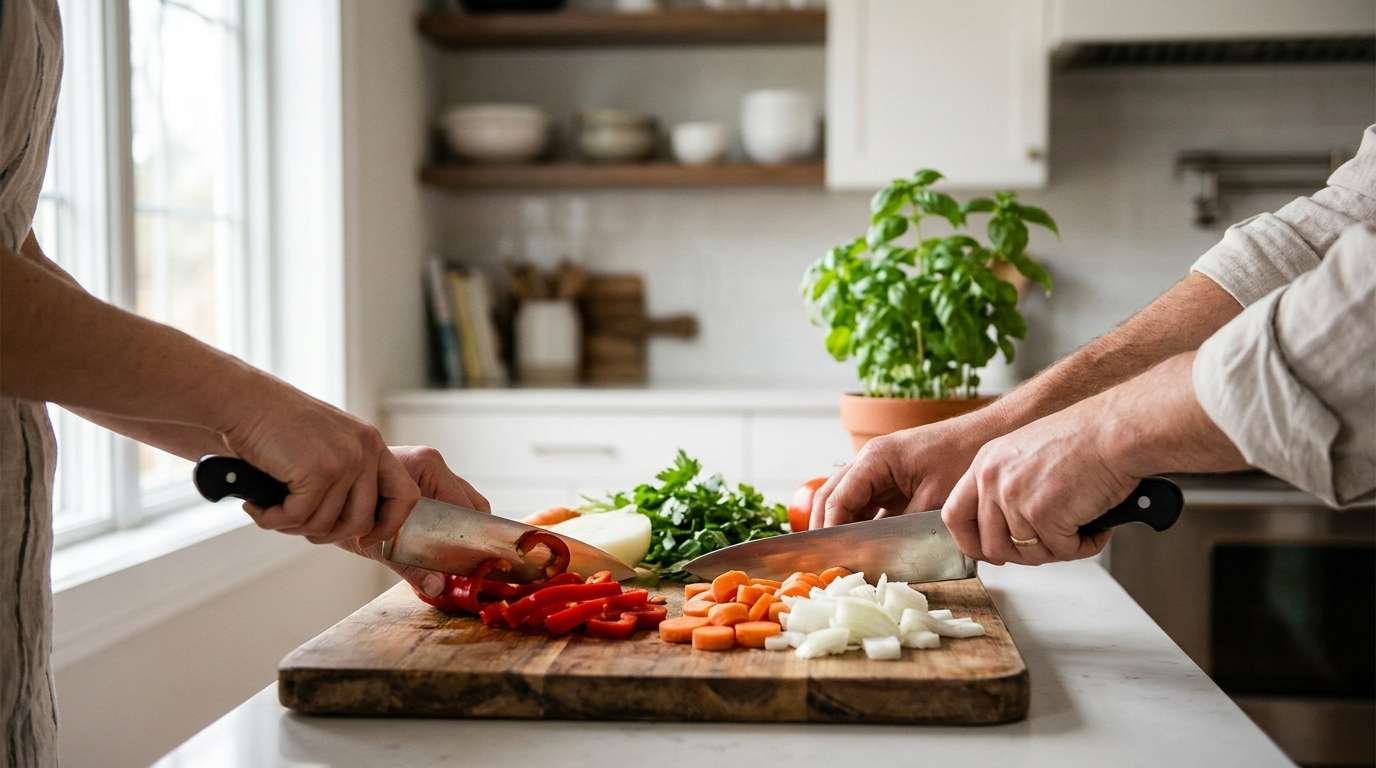

Good knife skills are one of the most useful abilities a home cook can develop. You don’t need professional-chef speed or an expensive knife collection. What matters is learning how to hold a knife safely, stabilize your food, make consistent cuts, and maintain your tools.
Better knife skills make cooking safer, faster, and more enjoyable. They also help ingredients cook more evenly because pieces of similar size tend to reach the desired texture at roughly the same time. If you’re building your kitchen confidence from the ground up, learning these techniques alongside cooking basics for beginners can give you a strong foundation for preparing everyday meals.
This guide covers the essential basic knife skills for home cooks, including knife safety, proper grip, cutting techniques, essential cuts, common mistakes, and simple practice exercises.
Table of Contents
What Are Basic Knife Skills?
Basic knife skills are the techniques used to safely and efficiently handle a kitchen knife, prepare ingredients, and make controlled cuts. They include proper knife grip, stabilizing food, slicing, chopping, dicing, mincing, and maintaining a sharp blade.
For beginners, the goal isn’t speed. Control and consistency should come first. Once your movements become comfortable, speed will naturally improve.
Why Knife Skills Matter in Home Cooking
Knife skills affect much more than the appearance of your food.
1. They improve kitchen safety
A controlled knife is generally easier to manage than one being used with rushed or awkward movements. Proper hand positioning also helps keep your fingers away from the cutting edge.
2. They improve cooking consistency
If one potato is cut into large chunks and another into tiny pieces, they won’t cook at the same rate. Uniform cuts help ingredients cook more evenly.
3. They save preparation time
A confident cook can prepare onions, vegetables, herbs, and other ingredients efficiently without constantly repositioning the food or knife.
4. They improve presentation
Consistent slices and evenly sized vegetables can make even a simple homemade meal look more polished.
5. They reduce frustration
Once basic knife movements become second nature, preparing ingredients becomes a smoother part of cooking rather than a slow, uncomfortable task.
The Most Important Knife Safety Rules
Before learning different cuts, learn how to control the knife.
Keep your cutting board stable
A cutting board that slides while you’re cutting creates unnecessary risk. Place a damp kitchen towel or nonslip mat underneath the board if it moves on your countertop.
Keep your knife sharp
A properly maintained knife is easier to control. A dull blade may require more pressure and can make cutting unpredictable.
Use a controlled grip
Don’t grip the knife loosely at the very end of the handle. Hold it securely and comfortably so you can guide the blade.
Keep your non-cutting hand protected
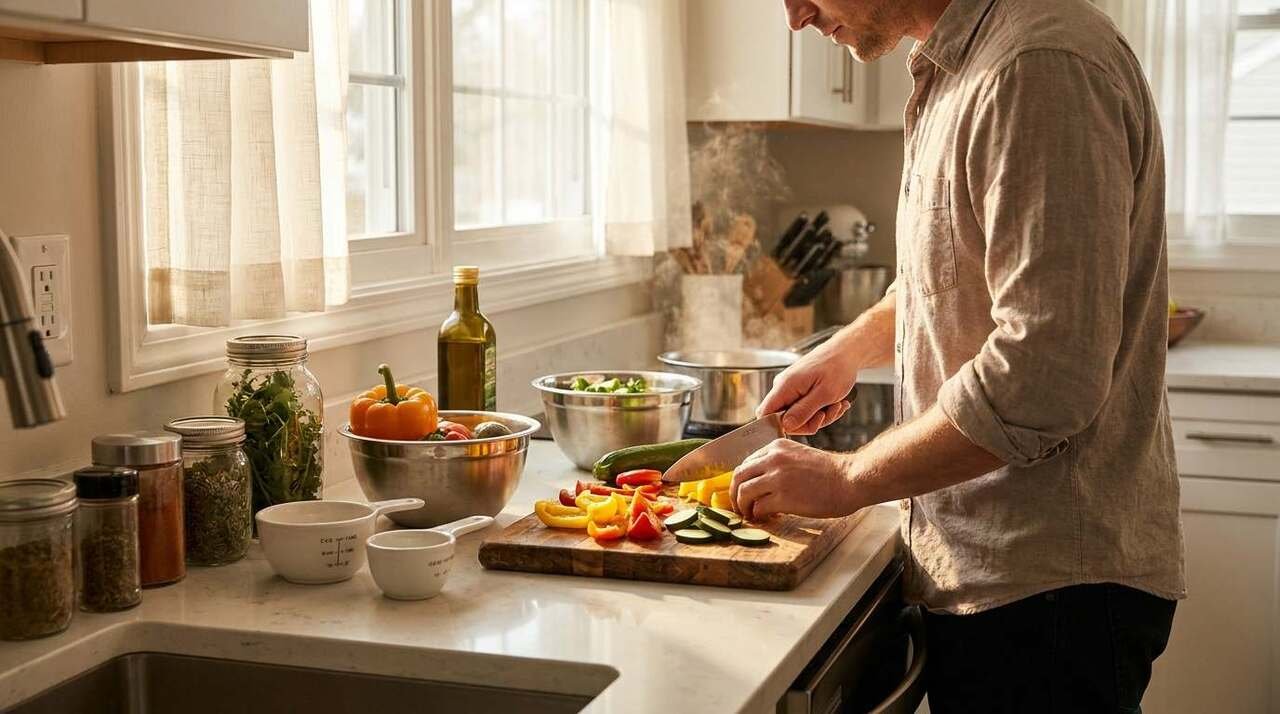
Use a claw grip when holding food. Curl your fingertips inward and use your knuckles as a guide for the side of the knife.
Your fingertips should stay behind your knuckles rather than extending toward the blade.
Cut on a stable surface
Never attempt to chop ingredients while holding them in your hand. Put them securely on the cutting board first.
Slow down when learning
Speed isn’t a measure of good knife skills. Beginners should focus on accurate, controlled movements rather than trying to imitate the rapid chopping seen in professional kitchens.
Don’t catch a falling knife
If a knife falls, step back and let it fall. Trying to grab it can cause an injury.
How to Hold a Kitchen Knife Correctly
Your knife grip influences both control and comfort.
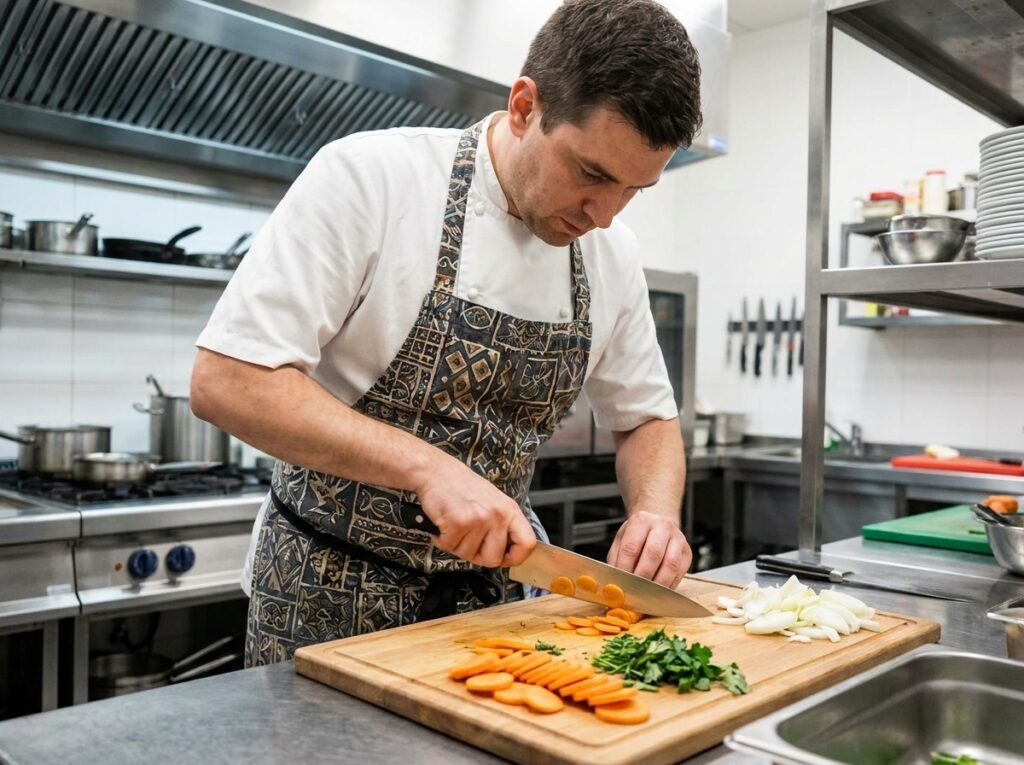
For most kitchen knives, hold the handle firmly but without excessive tension. A common professional-style grip places the thumb and index finger around the blade near the handle, while the remaining fingers wrap comfortably around the handle.
This gives you greater control over the blade than gripping only the far end of the handle.
Your wrist should remain relatively relaxed. Avoid squeezing the knife so tightly that your hand becomes tired.
Beginner tip: Practice holding the knife over the cutting board before adding food. Move the blade slowly through a few imaginary cutting motions until the grip feels natural.
Master the Claw Grip
The claw grip is one of the most important techniques for beginner cooks.
Place the fingertips of your non-dominant hand against the ingredient, then curl them slightly inward. Your knuckles should be positioned toward the side of the knife.
As the knife moves forward and backward, your knuckles help guide the blade while keeping your fingertips tucked away.
Think of the technique this way:
Fingertips tucked → knuckles forward → ingredient stable → controlled knife movement
Don’t force your fingers into an extreme position. The goal is simply to keep the fingertips away from the cutting path while maintaining a secure hold on the ingredient.
Essential Knife Cuts Every Home Cook Should Know
You don’t need to memorize dozens of culinary-school cuts. A handful of basic techniques will cover most everyday cooking.
1. Slicing
Slicing creates relatively thin pieces from ingredients such as:
- Cucumbers
- Tomatoes
- Carrots
- Mushrooms
- Onions
- Meat
- Fruit
For vegetables, create a stable flat surface whenever possible. Position the ingredient securely and use controlled strokes rather than aggressively pressing the knife straight down.
For softer ingredients, a sharp knife and smooth motion can help prevent crushing.
2. Chopping
Chopping generally produces larger, less precise pieces than dicing.
It’s useful for ingredients that will be cooked into soups, stews, sauces, casseroles, and other dishes where exact dimensions aren’t critical.
A simple chopping process is:
- Trim the ingredient as needed.
- Create a stable surface.
- Cut the ingredient into manageable sections.
- Make parallel cuts.
- Turn the pieces if needed.
- Make crosswise cuts.
Try to keep the pieces reasonably similar in size.
3. Dicing
Dicing creates small, relatively uniform cubes.
A practical approach is to first cut the ingredient into slabs or strips, then cut those strips into smaller pieces.
For example, when dicing a carrot:
Trim → cut into sections → create flat sides → slice into planks → cut into strips → cross-cut into cubes
The exact size can vary depending on the recipe.
Small dice
Small pieces work well for ingredients used in sauces, fillings, soups, and dishes where you want the ingredient to blend into the overall texture.
Medium dice
Medium dice are useful for many everyday vegetable preparations.
Large dice
Larger cubes are often suitable for roasting, stews, and hearty dishes.
The most important principle is consistency rather than obsessing over exact measurements.
4. Mincing
Mincing creates very small pieces.
It’s commonly used for:
- Garlic
- Fresh ginger
- Shallots
- Chilies
- Fresh herbs
To mince garlic, for example, first crush or finely slice the clove, then repeatedly cut across the pieces until you reach the desired texture.
A rocking motion can be useful with a chef’s knife, but keep the blade controlled and the cutting board stable.
5. Julienne
Julienne means cutting an ingredient into thin, matchstick-like strips.
Common examples include:
- Carrots
- Bell peppers
- Zucchini
- Cucumbers
Start by creating a stable shape, cut the ingredient into thin slices or planks, stack them carefully, and cut them into narrow strips.
Julienne cuts are particularly useful for stir-fries, salads, garnishes, and some noodle-style vegetable dishes.
6. Chiffonade
Chiffonade is commonly used for leafy ingredients such as basil, mint, spinach, and other tender greens.
Stack several leaves, roll them gently into a cylinder, and make thin crosswise cuts.
The result is long, delicate ribbons.
For delicate herbs such as basil, avoid excessive crushing because bruising can affect their appearance and texture.
Choosing the Right Knife
You don’t need a large collection of knives to develop good knife skills.
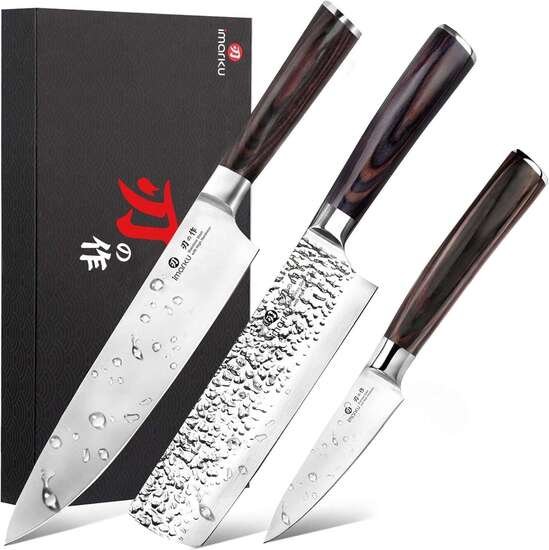
For most home kitchens, a few useful knives can handle the majority of preparation work.
| Knife | Best Uses |
|---|---|
| Chef’s knife | Chopping, slicing, dicing, mincing |
| Paring knife | Small fruits, vegetables, trimming |
| Serrated knife | Bread and soft-skinned foods |
| Utility knife | Smaller everyday cutting tasks |
A chef’s knife is usually the most versatile starting point.
Choose a knife that feels comfortable in your hand rather than assuming the most expensive option will automatically be the best.
How to Use a Chef’s Knife Efficiently
Many beginners try to cut by repeatedly lifting the knife high and bringing it straight down. That can work for some tasks, but controlled forward-and-back or rocking motions are often more efficient.
For chopping, keep the tip or lower portion of the blade controlled while moving through the ingredient.
For slicing, use smooth strokes rather than forcing the blade downward.
The exact technique depends on the ingredient and knife shape, so focus on smoothness, control, and consistency.
How to Cut an Onion Safely
Onions are one of the best ingredients for practicing basic knife skills.
A simple method:
- Trim the stem end while leaving the root end intact.
- Cut the onion in half through the root.
- Remove the skin.
- Place one half flat-side down.
- Make horizontal cuts if desired.
- Make vertical cuts toward the root.
- Make crosswise cuts to create diced pieces.
- Discard the root section.
Keep your non-cutting hand in the claw position.
The root helps hold the onion together while you work, making it easier to create controlled cuts.
How to Cut a Bell Pepper
Bell peppers can be awkward until you learn a simple approach.
- Cut off the top and bottom.
- Remove the seeds and inner membrane.
- Open the pepper into a flatter section.
- Place the flesh securely on the board.
- Slice into strips.
- Cut across the strips for diced peppers.
Removing the inner membrane can make the pepper easier to cut and gives you cleaner pieces.
How to Cut a Carrot
Start by trimming both ends.
For a round carrot, cut it into shorter sections if necessary. Then cut each section lengthwise to create a stable flat side.
Once stabilized, slice into planks, cut those planks into sticks, and cross-cut the sticks if you need diced carrots.
Key principle: Don’t try to dice a round, unstable carrot without first creating a flat surface.
Common Knife-Skill Mistakes to Avoid
Even simple habits can make cutting more difficult.
Using a dull knife
A dull blade can make clean cuts harder and may require excessive force.
Holding food with fingertips extended
This puts your fingertips closer to the blade. Use the claw grip instead.
Cutting unstable ingredients
Round ingredients can roll unexpectedly. Create a flat side whenever possible.
Chopping too quickly
Fast movements without control increase mistakes. Build accuracy first.
Using too much pressure
Let the knife do the cutting. Excessive force can make movements less controlled.
Using the wrong knife
A small paring knife isn’t the best tool for cutting a large squash, while a chef’s knife may be unnecessary for peeling a small fruit.
Ignoring your cutting board
A slippery board can turn even good knife technique into an unsafe situation.
How to Practice Knife Skills at Home
You don’t need special equipment or complicated recipes to practice.
Start with inexpensive vegetables that give you plenty of cutting opportunities.
Beginner practice routine
Practice 1: Slicing
Slice a cucumber into pieces of similar thickness.
Practice 2: Dicing
Dice a potato or carrot into reasonably uniform pieces.
Practice 3: Mincing
Practice mincing garlic or herbs.
Practice 4: Julienne
Cut a carrot into thin matchsticks.
Practice 5: Onion dice
Practice producing consistent diced onion pieces.
Don’t worry about speed. After several sessions, your hand movements will become more automatic.
A Simple Knife-Skills Progression
If you’re completely new to cooking, learn these techniques in order:
- Safe knife grip
- Stable cutting board setup
- Claw grip
- Basic slicing
- Chopping
- Dicing
- Mincing
- Julienne
- Chiffonade
- Faster, smoother preparation
This progression gives you the fundamentals without overwhelming you with advanced culinary terminology.
How to Keep Your Knife in Good Condition
Good knife skills depend partly on good equipment maintenance.
Clean the knife properly
Follow the manufacturer’s care instructions. In general, hand washing and careful drying are preferable for many quality kitchen knives.
Store knives safely
A knife block, magnetic strip, or suitable protective storage can help prevent blade damage and accidental contact.
Maintain the edge
Knife sharpening and honing serve different purposes. Honing can help realign an edge, while sharpening removes material to create a new edge.
If you’re unsure how to sharpen your particular knife, use a method appropriate for its construction or have it professionally sharpened.
The Golden Rule of Knife Skills
The most useful rule for beginners is simple:
Control beats speed.
Professional cooks may appear incredibly fast, but that speed comes from thousands of repetitions. Trying to copy their pace before developing control is unnecessary.
Instead, aim for:
- Stable ingredients
- A secure grip
- Protected fingertips
- Smooth movements
- Consistent cuts
- A properly maintained knife
- A stable cutting board
Once those habits become automatic, you’ll naturally become faster.
Quick Knife Skills Checklist
Before preparing your next meal, remember:
- Secure the cutting board.
- Use an appropriate, properly maintained knife.
- Hold the knife securely.
- Stabilize the ingredient.
- Keep your fingertips curled in a claw grip.
- Create a flat surface on round ingredients.
- Use controlled movements.
- Focus on consistency rather than speed.
- Keep the cutting area organized.
- Store the knife safely after cleaning and drying.
Key Takeaways
- Basic knife skills make cooking safer, easier, and more efficient.
- Control is more important than speed.
- A stable cutting board is essential.
- The claw grip helps protect your fingertips.
- Create flat surfaces when cutting round or unstable ingredients.
- A chef’s knife can handle most everyday preparation tasks.
- Slicing, chopping, dicing, and mincing are the most useful beginner cuts.
- Consistent ingredient sizes help promote even cooking.
- Proper knife maintenance improves cutting performance.
- Regular practice is the fastest path to confidence.
Frequently Asked Questions
What knife should a beginner home cook start with?
A chef’s knife is generally the most versatile starting point because it can handle chopping, slicing, dicing, and mincing. A comfortable grip and appropriate size matter more than choosing the most expensive knife.
How can I improve my knife skills quickly?
Practice a few basic cuts regularly rather than attempting complicated techniques. Focus on the claw grip, stable ingredients, consistent cuts, and controlled movements before working on speed.
Is a sharp knife safer than a dull knife?
A properly maintained sharp knife is generally easier to control because it can cut ingredients efficiently without excessive force. Regardless of sharpness, safe handling and proper technique remain essential.
What is the safest way to hold food while cutting?
Use a claw grip by curling your fingertips inward and positioning your knuckles toward the knife. This helps keep your fingertips away from the blade while stabilizing the ingredient.
Should vegetables be cut the same size?
They don’t always need to be identical, but pieces should generally be similar in size when they are cooking together. Consistent pieces promote more even cooking.
What is the difference between chopping and dicing?
Chopping typically produces irregular or relatively large pieces, while dicing aims to produce smaller, more uniform cubes.
How long does it take to learn basic knife skills?
The fundamentals can be learned quickly, but becoming genuinely comfortable takes regular practice. A few minutes of focused practice during meal preparation can gradually improve control and consistency.




Leave a Reply