
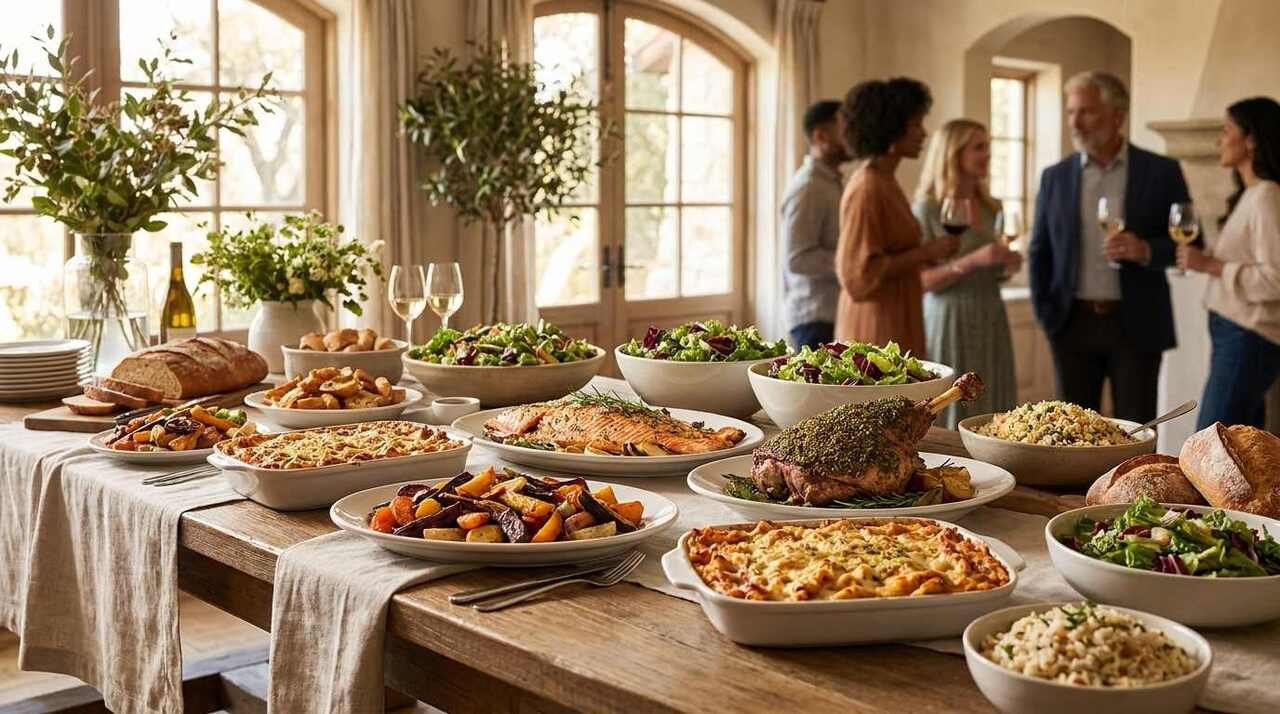

Cooking for large groups can feel overwhelming. Recipes that work perfectly for four people don’t always scale neatly to 20, 30, or 50 guests, and a crowded kitchen can quickly turn simple meal preparation into a logistical challenge.
The secret isn’t simply making more food. Successful cooking for large groups is about planning portions, choosing scalable recipes, organizing preparation, and managing cooking time efficiently.
Whether you’re preparing a family reunion, holiday dinner, birthday party, potluck, wedding reception, office lunch, or casual gathering, a good plan can make feeding a crowd surprisingly manageable.
This guide explains how to calculate portions, choose the right dishes, scale recipes, prepare food ahead of time, organize your kitchen, and avoid the most common mistakes when cooking for a large group.
Table of Contents
How Do You Cook for Large Groups?
Cooking for large groups means planning food around the number of guests, meal type, serving style, preparation time, cooking equipment, and dietary needs. The easiest approach is to choose dishes that can be prepared in large batches, calculate realistic portions, prepare ingredients ahead of time, and build extra time into the cooking schedule.
A successful large-group meal usually follows five basic steps:
- Estimate the number of guests.
- Calculate portions based on the type of meal.
- Choose recipes that scale well.
- Prepare as much as possible in advance.
- Create a cooking and serving schedule.
The larger the gathering, the more important organization becomes.
Start With the Guest Count
Before choosing recipes, determine exactly how many people you’re feeding.
Don’t automatically assume that multiplying a recipe by 10 will give you the right amount of food. Appetite, meal type, age, time of day, and the number of side dishes all affect how much people actually eat.
For example, a dinner with several substantial sides requires less of each individual dish than a buffet containing only one main course and two sides.
A Simple Portion Planning Guide
| Food Type | Approximate Portion Per Adult |
|---|---|
| Main protein | 6–8 oz cooked |
| Cooked pasta or grains | 1–1½ cups |
| Vegetables | 1–1½ cups |
| Salad | 1–2 cups |
| Side dish | ½–1 cup |
| Soup or stew | 1½–2 cups |
| Dessert | 1 serving |
| Bread | 1–2 pieces |
These are starting points rather than strict rules. Increase quantities when you’re serving a particularly hungry crowd or when a dish is expected to be the main attraction.
For children, portions can often be reduced significantly.
Don’t Forget Seconds
One of the most common mistakes when cooking for a crowd is planning for exactly one serving per person.
For a buffet or casual gathering, having some extra food is usually preferable to running out.
A practical approach is to plan approximately 10–15% more food for popular main dishes and staple sides when your budget and storage allow.
Choose Recipes That Scale Well
Not every recipe is designed to become a large-batch recipe.
The best recipes for large groups tend to have several things in common:
- They can be prepared in advance.
- They don’t require constant attention.
- They can be cooked in multiple pans.
- They hold their quality after cooking.
- They can be served buffet-style.
- They don’t depend on precise last-minute timing.
- Ingredients are easy to measure in bulk.
Best Foods for Large Groups
Some of the easiest dishes to prepare in quantity include:
- Chili
- Soups
- Stews
- Curries
- Baked pasta
- Lasagna
- Casseroles
- Pulled chicken
- Pulled pork
- Roasted vegetables
- Rice dishes
- Sheet-pan meals
- Taco fillings
- Grain bowls
- Large salads
- Sandwiches
- Pasta salads
These dishes are forgiving because they can usually be prepared in batches and kept warm without immediately losing their quality.
Foods That Require More Planning
Certain foods become difficult when you’re feeding dozens of people.
Examples include:
- Individual steaks
- Fried foods cooked one piece at a time
- Delicate seafood
- Soufflés
- Individual omelets
- Foods requiring precise plating
- Dishes that deteriorate quickly after cooking
You can still serve these foods, but you’ll need more equipment, helpers, cooking space, or a carefully timed production schedule.
How to Scale a Recipe for a Crowd
Recipe scaling is straightforward when the recipe uses ingredients that behave predictably.
Use this formula:
Scaling factor = Desired number of servings ÷ Original number of servings
Then multiply each ingredient by the scaling factor.
For example, if a recipe serves 6 people and you need 24 servings:
24 ÷ 6 = 4
Multiply the ingredients by four.
However, large-batch cooking isn’t always as simple as multiplying every ingredient.
Ingredients That May Need Adjustment
Some ingredients should be approached carefully when scaling.
These include:
- Salt
- Spices
- Thickening agents
- Leavening agents
- Cooking liquids
- Acidic ingredients
- Strong flavorings
Instead of automatically multiplying these ingredients, consider adding part of the calculated amount, tasting when appropriate, and adjusting gradually.
This is particularly useful for soups, sauces, curries, and stews.
Cooking Time Doesn’t Always Multiply
If a recipe normally takes 30 minutes, multiplying it by five doesn’t mean it should cook for 150 minutes.
Cooking time depends on:
- Depth of the food
- Pan size
- Oven capacity
- Quantity in each pan
- Starting temperature
- Crowding
- Cooking method
A large quantity of casserole is often better divided among several shallow baking dishes rather than placed into one extremely deep dish.
Build a Large-Group Menu Around One Main Dish
One of the easiest ways to simplify a large meal is to choose one reliable centerpiece.
For example:
Main: Slow-cooked pulled chicken
Starch: Rice
Vegetable: Roasted vegetables
Fresh side: Green salad
Bread: Dinner rolls
Dessert: Brownies or sheet cake
This works better than attempting to prepare several complicated entrées.
A good crowd menu usually contains:
- One main dish
- One filling starch
- One or two vegetable sides
- One fresh or acidic component
- Bread or another easy accompaniment
- One simple dessert
The goal isn’t to offer every possible food. It’s to create enough variety without creating unnecessary kitchen work.
Use Batch Cooking to Your Advantage
Batch cooking is one of the most important skills when feeding a crowd.
Instead of preparing each serving individually, prepare components in large quantities.
For example, rather than making 30 individual chicken dinners, prepare:
- A large batch of seasoned chicken
- A large batch of rice
- A tray of roasted vegetables
- A large salad
- One or two sauces
This reduces repetitive work and makes serving much faster.
Think in Production Lines
If you’re working with helpers, divide tasks.
One person might:
- Chop vegetables
Another can:
- Prepare sauces
Another can:
- Assemble casseroles
Another can:
- Set up the serving area
This approach keeps the kitchen moving and prevents everyone from trying to perform the same task at once.
Prepare as Much as Possible the Day Before
The day of the event should be about cooking and assembling—not discovering that 15 onions still need chopping.
Create a preparation list divided into three categories.
Two or More Days Ahead
Depending on the menu, you can:
- Purchase shelf-stable ingredients.
- Check equipment.
- Plan serving dishes.
- Prepare shopping lists.
- Make freezer-friendly desserts.
- Organize storage containers.
The Day Before
Complete tasks such as:
- Washing vegetables
- Chopping ingredients
- Preparing sauces
- Making marinades
- Cooking grains
- Preparing desserts
- Assembling casseroles
- Making dressings
- Setting the table
- Labeling serving dishes
The Day Of
Reserve the final hours for:
- Cooking mains
- Reheating prepared dishes
- Finishing vegetables
- Making fresh salads
- Garnishing
- Setting up the buffet
- Final seasoning
- Serving
This simple change can dramatically reduce last-minute pressure.
Create a Cooking Timeline
Large-group cooking becomes much easier when every dish has a place on the clock.
Suppose dinner is served at 6:00 p.m.
Your schedule might look like this:
| Time | Task |
| 1:00 p.m. | Begin long-cooking main dish |
| 2:00 p.m. | Prepare vegetables |
| 3:00 p.m. | Assemble casseroles |
| 4:00 p.m. | Start baking dishes |
| 4:30 p.m. | Prepare salad and dressing |
| 5:00 p.m. | Begin reheating |
| 5:20 p.m. | Prepare serving station |
| 5:40 p.m. | Final seasoning and garnishing |
| 5:50 p.m. | Transfer food to serving dishes |
| 6:00 p.m. | Serve |
The exact schedule will vary, but the principle remains the same: work backward from serving time.
Always identify which dishes need the most attention and which can wait.
Don’t Underestimate Oven and Refrigerator Space
A menu may look perfect on paper but fail because your kitchen cannot physically handle it.
Before finalizing your menu, check:
- How many oven racks you have
- Oven capacity
- Number and size of baking dishes
- Refrigerator space
- Freezer space
- Stovetop burners
- Large pots
- Mixing bowls
- Cutting boards
- Serving platters
- Storage containers
If you’re cooking for 30 people but only have one small oven, don’t build a menu around six dishes that all need to bake simultaneously.
Instead, choose dishes that use different cooking methods.
For example:
Oven: Roasted vegetables
Stovetop: Rice
Slow cooker: Chili
Refrigerator: Salad
No-cook: Bread and fruit
This spreads the workload across your available equipment.
Keep Food Safe When Serving a Crowd
Food safety becomes especially important when large quantities are involved.
Large containers of food can cool slowly, and food sitting out during a long buffet can create additional safety concerns.
Use appropriate food-storage and temperature-control practices, and don’t rely on appearance or smell to determine whether food is safe.
Practical Food-Safety Habits
- Wash hands frequently.
- Keep raw meat separate from ready-to-eat foods.
- Use clean utensils for serving.
- Avoid leaving perishable food unattended for long periods.
- Divide large quantities into smaller containers when cooling.
- Refrigerate leftovers promptly.
- Keep hot foods hot and cold foods cold using appropriate equipment.
- Use a food thermometer when temperature matters.
If you’re hosting a particularly large event, consider using chafing dishes, insulated carriers, coolers, or other suitable food-holding equipment.
Make the Buffet Easy to Navigate
A well-organized buffet can make serving 30 people feel much easier than serving 10 people from a cramped kitchen table.
Arrange foods in the order guests naturally need them:
Plates → Main dish → Starches → Vegetables → Salads → Sauces → Bread → Cutlery → Napkins
If space allows, place beverages at a separate station.
This prevents guests from blocking the food line while filling drinks.
Put Serving Utensils With Each Dish
Every dish should have its own:
- Serving spoon
- Tongs
- Ladle
- Pie server
- Fork
depending on the food.
This small detail prevents a surprising amount of confusion.
How Much Food Should You Make?
There’s no universal quantity because menus vary, but portion planning becomes easier when you think about the entire meal rather than individual recipes.
For a buffet dinner, for example, you might allocate:
- A substantial serving of the main protein
- A moderate serving of starch
- One or two vegetable portions
- A salad
- Bread
- Dessert
If there are many sides, guests naturally take smaller portions of each.
If there’s only one main dish and a couple of sides, increase the quantity of the core foods.
A Simple Crowd-Planning Formula
For each major dish, ask:
How many servings does one batch produce?
Then:
Number of batches = Required servings ÷ Servings per batch
Round up rather than down when the dish is inexpensive, popular, or difficult to prepare again during the event.
Choose Make-Ahead Desserts
Dessert shouldn’t become the dish that ruins your schedule.
The best desserts for large groups are often those that can be prepared ahead of time and portioned easily.
Good options include:
- Brownies
- Sheet cake
- Cookies
- Fruit crumble
- Cheesecake bars
- Rice pudding
- Cupcakes
- Dessert squares
- Large fruit salads
A sheet cake is particularly useful because it can provide many servings without requiring individual decoration.
Common Mistakes When Cooking for Large Groups
Even experienced home cooks can run into problems when the quantity increases.
1. Choosing Too Many Recipes
More dishes don’t automatically mean a better meal.
A smaller menu executed well is usually better than an ambitious menu where everything competes for oven space.
2. Cooking Everything From Scratch on the Same Day
This creates unnecessary pressure.
Move as many tasks as possible to the day before.
3. Forgetting Serving Equipment
You can have perfectly prepared food and still struggle if you don’t have enough:
- Serving spoons
- Plates
- Bowls
- Cups
- Cutlery
- Napkins
- Trays
Add these to the planning checklist.
4. Scaling Every Ingredient Blindly
Large-batch recipes may need adjustments for seasoning, liquid, pan size, and cooking method.
5. Ignoring Dietary Restrictions
Ask guests ahead of time about major dietary requirements.
Depending on your group, you may need vegetarian, vegan, gluten-free, dairy-free, nut-free, or allergy-aware options.
Keep special dishes clearly identified and avoid cross-contact when preparing allergy-sensitive food.
6. Running Out of One Popular Dish
If one dish is clearly the star of the meal, give it extra attention when calculating portions.
7. Leaving No Buffer
Unexpected delays happen.
Build extra time into your cooking schedule instead of planning every task down to the final minute.
A Practical Large-Group Cooking Checklist
Use this checklist before your next gathering.
One Week Before
- Confirm guest count
- Choose the menu
- Check dietary requirements
- Calculate ingredient quantities
- Create the shopping list
- Check kitchen equipment
- Check serving dishes
Two to Three Days Before
- Shop for ingredients
- Purchase drinks
- Check storage containers
- Prepare freezer-friendly items
- Organize the kitchen
The Day Before
- Chop vegetables
- Prepare sauces
- Make desserts
- Cook make-ahead dishes
- Assemble casseroles
- Label prepared foods
- Set out serving equipment
Event Day
- Start long-cooking dishes first
- Follow the cooking timeline
- Prepare fresh components
- Check food temperatures
- Set up the buffet
- Put serving utensils with dishes
- Keep backup portions stored safely
- Save time for cleanup
The Best Strategy: Simplify the Menu, Not the Experience
Cooking for a large group doesn’t require an elaborate restaurant-style menu.
In fact, the most successful gatherings often rely on simple food prepared well.
Choose dishes that:
- Scale easily
- Taste good when reheated
- Can be prepared ahead
- Use overlapping ingredients
- Don’t require constant attention
- Can be served buffet-style
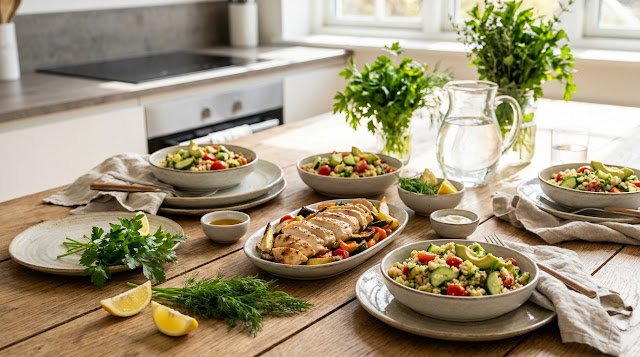
For example, a large tray of baked pasta, a crisp salad, roasted vegetables, warm bread, and an easy dessert can feel abundant without requiring a professional kitchen.
The goal is to make the meal feel generous while keeping the workload manageable.
Key Takeaways
- Plan portions according to the entire menu, not individual dishes.
- Choose recipes that scale well and can be prepared in batches.
- Don’t assume cooking time increases proportionally with quantity.
- Prepare as many ingredients as possible before the event.
- Work backward from your serving time to create a cooking schedule.
- Check oven, refrigerator, stovetop, and serving capacity before finalizing the menu.
- Keep food safety a priority when cooking and serving large quantities.
- Use a buffet layout that keeps guests moving efficiently.
- Choose make-ahead desserts and sides whenever possible.
- A simple, well-organized menu is usually better than an overly complicated one.
Final Thought
The biggest secret to cooking for large groups isn’t a complicated recipe or expensive equipment. It’s organization.
When you know how many people you’re feeding, choose dishes that scale well, prepare ahead, schedule your cooking, and organize your serving area, feeding a crowd becomes far more manageable.
Plan the workload—not just the menu—and you can spend less time worrying about the kitchen and more time enjoying the people around your table.
Frequently Asked Questions
What are the easiest foods to cook for a large group?
Chili, soups, stews, curries, baked pasta, casseroles, pulled meats, rice dishes, roasted vegetables, salads, sandwiches, and sheet-pan meals are generally easier to prepare in large quantities than individually cooked foods.
How much food should I prepare for 20 people?
The amount depends on the menu, appetite, meal type, and number of side dishes. Start by calculating realistic portions per person, then add a modest buffer for popular dishes and seconds rather than simply multiplying a recipe without adjustment.
Can I multiply a recipe by 10?
You can use the recipe’s serving ratio as a starting point, but not every ingredient should necessarily be scaled blindly. Salt, spices, liquids, thickeners, and certain leavening ingredients may require adjustment.
What should I cook the day before a large party?
Prepare ingredients and dishes that hold well, such as sauces, desserts, chopped vegetables, marinades, casseroles, cooked grains, dressings, and some main dishes. This leaves less work for the event day.
How do I keep food warm for a large group?
Use suitable equipment such as chafing dishes, insulated food carriers, warming equipment, or appropriately sized covered containers. Monitor food rather than assuming it will remain at a safe temperature.
What is the best dessert for a large crowd?
Brownies, sheet cakes, cookies, dessert bars, fruit crumbles, and other easily portioned desserts are practical because they can usually be made ahead and served without complicated plating.
How do I feed a large group on a budget?
Build the menu around affordable, filling ingredients such as beans, rice, pasta, potatoes, seasonal vegetables, grains, and batch-cooked proteins. Choose dishes that use overlapping ingredients and avoid recipes requiring many individual portions.
How far ahead should I plan a large meal?
For a small family gathering, several days may be enough. Larger events benefit from starting at least a week ahead so you have time to confirm the guest count, plan the menu, shop, check equipment, and organize preparation.

Leave a Reply