
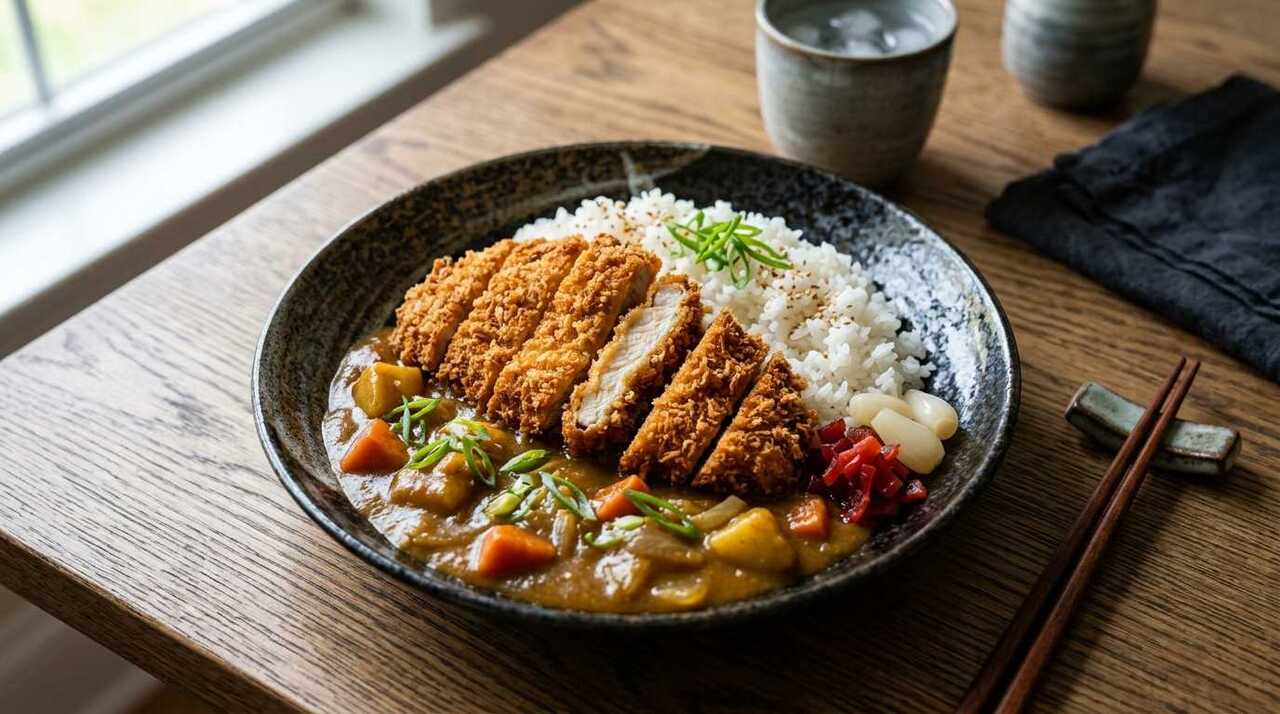

Chicken katsu curry brings together two of Japan’s most comforting dishes: crisp, golden chicken cutlets and a rich, savory curry sauce. The contrast is what makes it so satisfying. We get crunchy breaded chicken, tender meat, fluffy rice, and a mildly sweet curry sauce in every serving.
Unlike some curries that depend on intense heat, Japanese-style curry is generally smooth, aromatic, and deeply savory. It is especially well suited to chicken katsu because the sauce adds moisture and richness without completely hiding the crisp coating.
This recipe gives us a practical way to prepare chicken katsu curry at home, from preparing the chicken to building a flavorful curry sauce and assembling the finished plate.
Suggested reads: Japanese Cooking Techniques: 5 Essential Methods
Table of Contents
What Is Chicken Katsu Curry?
Chicken katsu curry is a Japanese-inspired dish made with breaded and fried chicken cutlets served with Japanese curry and rice. “Katsu” refers to a breaded cutlet, while “curry” describes the thick, savory sauce commonly served alongside it.
The chicken is typically coated in flour, beaten egg, and panko breadcrumbs before being fried until crisp and golden. The curry is prepared separately with ingredients such as onion, carrot, potato, curry roux, and stock.
We then slice the chicken into strips and serve it over steamed rice, spooning the curry around or alongside the cutlet.
The result is a complete meal with several contrasting textures:
- Crispy chicken
- Tender interior
- Soft steamed rice
- Thick, silky curry sauce
- Sweet and savory vegetables
- Aromatic Japanese curry spices
Ingredients for Chicken Katsu Curry
For the best texture, we recommend preparing the chicken and curry separately before bringing everything together.
For the Chicken Katsu
- 2 boneless, skinless chicken breasts
- ½ cup all-purpose flour
- 2 large eggs
- 1½ cups panko breadcrumbs
- ½ teaspoon salt
- ¼ teaspoon black pepper
- Neutral oil for frying
Chicken breasts work particularly well because they can be flattened to an even thickness. This allows the coating to become crisp while the chicken cooks evenly.
For extra flavor, we can season the chicken directly before breading. Keeping the seasoning simple allows the curry sauce to remain the dominant flavor.
For the Japanese Curry
- 1 tablespoon neutral cooking oil
- 1 medium onion, sliced
- 1 carrot, peeled and chopped
- 2 medium potatoes, peeled and cubed
- 3 cups chicken stock
- Japanese curry roux, according to package directions
- 1 tablespoon soy sauce
- 1 teaspoon honey or sugar, optional
Japanese curry roux provides the characteristic thick consistency, savory seasoning, and warm spice profile associated with this style of curry.
For Serving
- Steamed white rice
- Sliced chicken katsu
- Japanese curry sauce
- Sliced green onions, optional
- Pickled ginger or Japanese pickles, optional
How to Prepare Chicken Katsu
The first step is preparing the chicken so that it cooks evenly.
Place each chicken breast on a sturdy cutting board and carefully slice it horizontally or gently pound it until it reaches an even thickness. We want the chicken to be thin enough to cook quickly but substantial enough to remain juicy.
Season both sides with salt and black pepper.
Set up three shallow dishes. Place flour in the first, beaten eggs in the second, and panko breadcrumbs in the third.
Coat each chicken breast in flour, shaking off the excess. Dip it into the beaten egg, allowing any excess to drip away, and finally press it firmly into the panko breadcrumbs.
The panko should form an even layer over the chicken. Pressing the breadcrumbs gently against the surface helps create a more substantial crust.
Allow the breaded chicken to rest for a few minutes before frying. This gives the coating a chance to adhere more securely.
How to Make Japanese Curry Sauce
While the chicken rests, we can prepare the curry.
Heat the cooking oil in a saucepan or Dutch oven over medium heat. Add the sliced onion and cook until it begins to soften and turn lightly golden.
Add the carrots and potatoes and cook for several minutes, stirring occasionally.
Pour in the chicken stock and bring the mixture to a gentle boil. Reduce the heat and simmer until the vegetables are tender.
At this stage, add the Japanese curry roux according to the package instructions. Stir continuously enough to dissolve the roux smoothly into the liquid.
The sauce should gradually become thick, glossy, and spoon-coating.
If desired, add a small amount of soy sauce for additional savory depth. A touch of honey or sugar can also balance the natural bitterness of the curry spices and bring out the sweetness of the onions.
Keep the curry warm over low heat while preparing the chicken.
How to Fry Chicken Katsu
Pour enough neutral oil into a heavy skillet to provide a generous frying layer. Heat the oil over medium to medium-high heat.
To check whether the oil is ready, drop a few panko crumbs into it. They should immediately begin bubbling without burning.
Carefully place the breaded chicken into the hot oil.
Cook until the underside becomes deep golden brown and crisp. Turn the chicken carefully and continue cooking until the other side is equally golden and the chicken is fully cooked.
Avoid overcrowding the pan. Frying too many pieces at once can lower the oil temperature, producing a greasy rather than crisp coating.
Once cooked, transfer the chicken to a wire rack or paper-lined plate.
Allow it to rest briefly before slicing. Cutting immediately can cause some of the juices to escape.
The Secret to Extra-Crispy Chicken Katsu
The coating is one of the defining features of chicken katsu, so texture matters.
Panko breadcrumbs are preferable to ordinary fine breadcrumbs because their larger flakes create a lighter, crunchier crust.
We should also avoid pressing the finished breading too aggressively. The goal is to create a complete coating while preserving some of the irregular panko texture.
Another important detail is oil temperature. Oil that is too cool allows the breadcrumbs to absorb excess oil. Oil that is excessively hot can brown the coating before the chicken cooks through.
Maintaining a steady medium to medium-high temperature gives us the best balance between crispness and properly cooked chicken.
How to Assemble Chicken Katsu Curry
Start with a generous portion of steamed rice on one side of a wide bowl or plate.
Slice the chicken katsu into strips using a sharp knife. Arrange the pieces beside or partially over the rice.
Spoon the Japanese curry over the rice, leaving enough of the chicken exposed so that the crisp coating remains visible.
For the best texture, avoid completely drowning the chicken in curry. The sauce is rich and moist, while the chicken should retain some of its crunch.
Finish with sliced green onions or Japanese pickles if desired.
The finished plate should offer a combination of crisp chicken, creamy curry, fluffy rice, and tender vegetables.
Best Rice for Chicken Katsu Curry
Short- or medium-grain Japanese-style white rice is an excellent choice because it has enough stickiness to hold together without becoming mushy.
The rice should be freshly steamed and served hot.
We can also use another neutral rice variety when Japanese rice is unavailable. The important point is to choose rice that does not overpower the curry.
Avoid heavily seasoned rice because the curry already provides substantial flavor.
Common Chicken Katsu Curry Mistakes
Using Thin Breadcrumbs
Fine breadcrumbs can create a dense coating. Panko gives the chicken a more characteristic crunchy texture.
Frying at the Wrong Temperature
If the oil is too cool, the chicken may become greasy. If it is too hot, the crust can burn before the center is cooked.
Making the Curry Too Thin
Japanese curry should generally be thicker than many South Asian curries. It needs enough body to cling to rice rather than spreading like a broth.
Overcooking the Chicken
Thin chicken cooks relatively quickly. We should monitor it carefully and avoid leaving it in the oil longer than necessary.
Covering the Entire Katsu With Curry
Although it is tempting to pour curry over everything, doing so can soften the crispy crust. Keeping some of the chicken exposed preserves the contrast that makes this dish so enjoyable.
Easy Ways to Customize the Curry
Chicken katsu curry is flexible enough to accommodate different preferences.
For additional vegetables, we can add sliced mushrooms, peas, bell peppers, or extra carrots.
For a slightly sweeter curry, increase the amount of caramelized onion or add a small amount of honey.
For more savory depth, a little soy sauce can complement the curry roux.
Those who prefer more heat can add chili flakes or Japanese chili seasoning at the table rather than changing the entire curry sauce.
We can also make the curry ahead of time. In fact, the sauce often develops a deeper flavor after resting and reheating.
How to Store Leftover Chicken Katsu Curry
For the best texture, store the chicken, curry, and rice separately.
Place the curry in an airtight container and refrigerate it promptly. Store the cooked chicken separately so its coating does not absorb moisture from the sauce.
Rice should also be cooled and refrigerated properly rather than left at room temperature for an extended period.
When reheating, warm the curry thoroughly. Reheat the chicken using an oven, toaster oven, or air fryer when possible. This helps restore some of the crispness that would be lost in a microwave.
The rice can be reheated separately with a small amount of moisture to prevent it from drying out.
Can Chicken Katsu Curry Be Made Ahead?
Yes. The curry sauce is particularly convenient for advance preparation.
We can prepare the curry several hours or even a day ahead and refrigerate it. When ready to serve, reheat it gently and adjust the consistency with a small amount of stock or water if necessary.
For the crispiest chicken, however, it is better to cook the katsu relatively close to serving time.
The chicken can be breaded ahead of time and refrigerated until ready to fry, provided it is kept properly chilled.
What to Serve With Chicken Katsu Curry
Chicken katsu curry is already a complete meal, but simple accompaniments can add contrast.
Japanese pickles provide acidity that cuts through the richness of the curry and fried chicken.
A simple cucumber salad can provide freshness, while steamed vegetables add another nutritious component without competing with the main dish.
For a classic presentation, we can keep the plate simple: steamed rice, chicken katsu, curry, and a small pickle garnish.
Final Thoughts
Chicken katsu curry works because every component brings something different to the plate. The panko-coated chicken provides crunch, the Japanese curry contributes warmth and richness, and steamed rice creates a mild foundation that brings everything together.
By keeping the chicken crisp, the curry thick and flavorful, and the rice freshly steamed, we can create a satisfying homemade version of this Japanese comfort-food favorite.
The most important technique is simple: prepare each component properly and assemble them just before serving. That preserves the contrast between the crunchy katsu and smooth curry that makes chicken katsu curry such a memorable meal.


Leave a Reply