
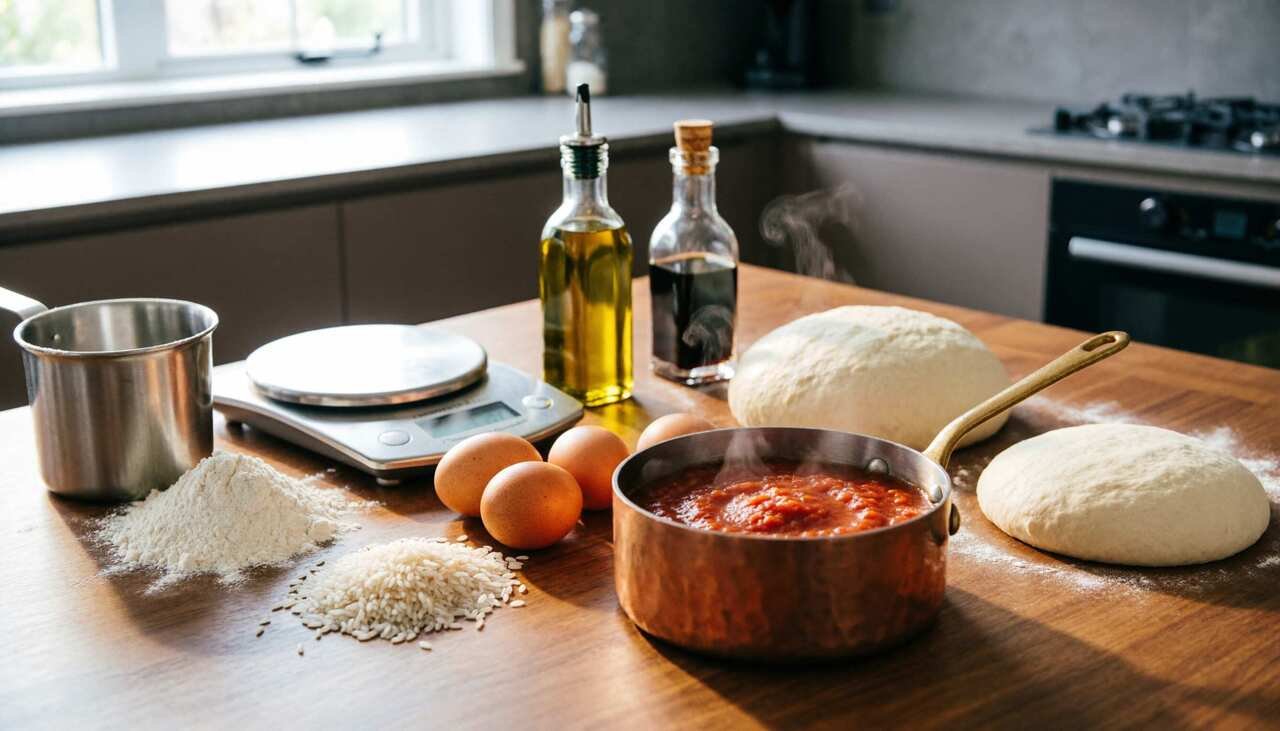

Cooking becomes much easier when you stop thinking of recipes as rigid lists of ingredients and start understanding the ratios behind them. A good ratio gives you a flexible formula you can scale, adjust, and reuse—even when you don’t have the exact recipe in front of you.
From vinaigrettes and sauces to rice, pancakes, bread, and pizza dough, many everyday kitchen preparations follow surprisingly simple mathematical relationships. Once you understand these formulas, you can make sensible substitutions, change serving sizes, and troubleshoot recipes with greater confidence.
The goal isn’t to memorize dozens of recipes. It’s to learn a handful of essential cooking ratios that help you understand why a recipe works.
Table of Contents
What Is a Cooking Ratio?
A cooking ratio describes the relationship between two or more ingredients rather than specifying one fixed quantity.
For example, a simple vinaigrette often follows a 3:1 ratio of oil to acid. That means you could use 3 tablespoons of oil with 1 tablespoon of vinegar, or scale it up to 6 tablespoons of oil and 2 tablespoons of vinegar.
Ratios are useful because they:
- Make recipes easier to memorize
- Allow recipes to be scaled up or down
- Help with ingredient substitutions
- Make troubleshooting easier
- Give you a starting point when improvising
- Reduce dependence on exact recipes
The most important skill is understanding that a ratio is a starting framework, not an unbreakable rule. Ingredients differ in strength, moisture, density, and flavor, so experienced cooks adjust formulas according to the result they want.
The Most Useful Cooking Ratios at a Glance
| Preparation | Basic Ratio or Formula | Main Purpose |
|---|---|---|
| Vinaigrette | 3 parts oil : 1 part acid | Balanced dressing |
| Rice | Varies by rice type | Proper hydration |
| Pancakes | 1 part flour : 1 part liquid by volume as a starting point | Flexible batter |
| Simple bread | Flour : water : yeast : salt | Dough structure |
| Pizza dough | Flour : water : yeast : salt | Elastic dough |
| Sauce | Fat + flour + liquid | Thickened sauce |
| Recipe scaling | Original quantity × scaling factor | Change yield |
| Serving adjustment | Desired servings ÷ original servings | Recalculate portions |
These formulas are useful because they describe relationships. However, rice is a good example of why you shouldn’t apply one universal ratio to every ingredient: different varieties and cooking methods require different amounts of water.
1. Basic Vinaigrette Ratio
A classic vinaigrette provides one of the easiest cooking ratios to remember: 3 parts oil to 1 part acid.
The oil provides richness and body, while the acid—such as vinegar or lemon juice—adds brightness. The ratio can be adjusted depending on the ingredients and your personal preference.
A basic formula is:
3 parts oil + 1 part acid + seasoning
For example:
- 3 tablespoons olive oil
- 1 tablespoon vinegar
- Salt and pepper
You can then add mustard, honey, herbs, garlic, shallot, or other flavorings.
If the dressing tastes too sharp, increase the oil. If it tastes flat or overly rich, add a little more acid.
For a deeper explanation of proportions and variations, see Basic Vinaigrette Ratio.
Why the Ratio Works
Oil and acid don’t naturally stay mixed for long. Whisking or shaking them creates a temporary emulsion. Ingredients such as Dijon mustard can help stabilize the mixture.
The ratio also gives you a useful flavor-control system. Rather than blindly adding more ingredients, adjust one side of the relationship.
Too acidic? Add oil.
Too oily? Add acid.
Tastes dull? Adjust salt before automatically adding more acid.
2. Rice-to-Water Ratios Explained
Rice looks simple, but it is one of the ingredients where ratios require the most care.
The correct rice-to-water ratio depends on:
- Rice variety
- Cooking method
- Whether the rice is rinsed
- Pot shape and size
- Cooking temperature
- Desired texture
- Whether the rice is covered
For this reason, there isn’t one universal rice formula that works equally well for every variety.
A useful starting point is to think about the amount of water required to hydrate the particular rice you’re cooking rather than assuming every grain follows the same rule.
For example, long-grain white rice, brown rice, basmati, jasmine, and specialty varieties can behave differently.
The best approach is to start with the manufacturer’s or recipe’s recommended ratio, then make small adjustments based on your results.
If your rice repeatedly turns out mushy, the problem may be too much water, excessive cooking, or insufficient evaporation. If it remains firm, it may need more liquid or cooking time.
For a deeper guide to choosing the right amount of water, read Rice-to-Water Ratios Explained.
A Useful Rice Troubleshooting Formula
Instead of changing several variables at once, change only one:
- Keep the rice quantity constant.
- Adjust the water slightly.
- Keep the cooking time consistent.
- Record the result.
- Repeat if necessary.
This turns rice cooking into a simple controlled experiment.
3. The Basic Pancake Formula
Pancakes are another excellent example of ratio-based cooking because the batter can be adjusted easily.
A simple pancake formula starts with:
Flour + liquid + egg + fat + leavening + salt
A practical starting point is approximately equal volumes of flour and liquid, followed by eggs and smaller quantities of fat, baking powder, and salt.
The exact proportions aren’t as important as understanding what each ingredient does.
Flour
Flour provides structure.
Liquid
Milk or another liquid hydrates the flour and determines batter consistency.
Eggs
Eggs contribute structure, richness, and binding.
Fat
Butter or oil improves tenderness and flavor.
Baking Powder
A chemical leavener creates bubbles that help pancakes rise.
If the batter is too thick, add liquid gradually. If it’s too thin, add a small amount of flour.
Don’t overmix once the flour has been hydrated. Excessive mixing can develop gluten and produce tougher pancakes.
For a more detailed breakdown of the formula, see The Basic Pancake Formula.
The Best Visual Test
Instead of relying only on measurements, learn to recognize the desired batter consistency. It should generally pour easily but still have enough body to coat the cooking surface rather than behaving like milk.
This is where ratio-based cooking becomes more useful than blindly following numbers.
4. Simple Bread Ratio for Beginners
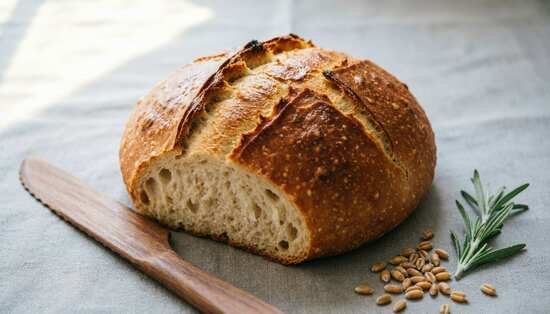
Bread formulas are often expressed using baker’s percentages, a professional system that makes scaling extremely easy.
The most important ingredient is flour, which is always treated as 100%.
A simple bread formula might look like:
- Flour: 100%
- Water: 60–70%
- Salt: around 2%
- Yeast: a small percentage depending on fermentation time
The water percentage is called hydration.
For example, if you have 500 grams of flour and use 65% hydration:
500 × 0.65 = 325 grams of water
You can then calculate the other ingredients from the flour weight.
This method is much more flexible than memorizing one fixed bread recipe.
For beginners learning the fundamentals, Simple Bread Ratio for Beginners is a useful next step.
Why Baker’s Percentages Matter
Imagine you want to make twice as much bread. With a traditional recipe, you have to multiply every ingredient.
With baker’s percentages, the formula already expresses every ingredient in relation to the flour.
That makes it easy to:
- Change loaf size
- Compare recipes
- Adjust hydration
- Experiment with fermentation
- Maintain consistent proportions
Understanding Hydration
Higher hydration generally produces wetter dough that can become more open and extensible, while lower hydration creates a firmer dough.
But hydration isn’t the only factor affecting the final bread. Flour type, kneading, fermentation, temperature, and shaping all matter.
5. Basic Pizza Dough Formula
Pizza dough follows many of the same principles as bread, which makes baker’s percentages especially useful.
A straightforward pizza dough framework might include:
- Flour: 100%
- Water: approximately 60–70%
- Salt: around 2–3%
- Yeast: a small percentage
For example, with 500 grams of flour:
- 500 g flour
- 325 g water at 65% hydration
- 10–15 g salt depending on the formula
- Yeast according to fermentation time and method
The exact formula can vary substantially depending on whether you’re making a same-day pizza, an overnight dough, or a long-fermented dough.
For a dedicated breakdown of the formula, see Basic Pizza Dough Formula.
Pizza Dough Is More Than a Ratio
Two doughs can have identical ingredient percentages but produce different results.
Fermentation time, dough temperature, flour strength, kneading, and baking temperature all influence the finished crust.
That’s why ratios should be viewed as the architecture of the recipe, while technique determines much of the final character.
6. How to Make a Sauce Using a Simple Formula
Many classic sauces can be understood as formulas rather than complicated recipes.
One of the most useful frameworks for a thickened sauce is:
Fat + flour + liquid
This is the basic structure behind a roux-based sauce.
For example:
- Melt butter or another cooking fat.
- Add flour.
- Cook the mixture briefly.
- Gradually whisk in liquid.
- Simmer until thickened.
- Season to taste.
The exact quantity of liquid determines how thick the sauce becomes.
Why the Order Matters
Adding the liquid gradually helps prevent lumps and allows the flour-and-fat mixture to disperse evenly.
Once you understand the basic formula, you can create variations using:
- Milk
- Stock
- Cream
- Cheese
- Herbs
- Spices
- Mustard
- Aromatics
For more ideas on building sauces from proportions, explore How to Make a Sauce Using a Simple Formula.
A General Sauce-Building Framework
When improvising a sauce, ask four questions:
What provides fat?
Butter, oil, cream, or another fat can contribute richness.
What provides liquid?
Stock, milk, wine, water, tomato products, or cooking juices can form the liquid base.
What creates thickness?
Flour, starch, reduction, dairy, or another thickening mechanism can change consistency.
What provides flavor?
Salt, herbs, spices, aromatics, acids, cheese, or concentrated ingredients complete the sauce.
This framework lets you troubleshoot without starting over.
7. How to Double or Halve a Recipe
Recipe scaling is one of the most practical applications of ratios.
The basic formula is:
Scaling factor = desired quantity ÷ original quantity
If a recipe makes 4 servings and you want 8:
8 ÷ 4 = 2
Multiply every ingredient by 2.
If you want 2 servings:
2 ÷ 4 = 0.5
Multiply every ingredient by 0.5.
For example, if a recipe contains:
- 2 cups flour
- 1 cup milk
- 2 eggs
Doubling gives:
- 4 cups flour
- 2 cups milk
- 4 eggs
Halving gives:
- 1 cup flour
- ½ cup milk
- 1 egg
For more examples and practical scaling guidance, read How to Double or Halve a Recipe.
Ingredients That Need Extra Attention
Scaling isn’t always perfectly mechanical.
Be particularly careful with:
- Salt
- Spices
- Leavening agents
- Strong flavorings
- Cooking liquids
- Eggs
A recipe doubled exactly may not always taste or behave exactly twice as intense.
When scaling large batches, use the formula as a starting point and adjust seasoning after tasting when appropriate.
8. How to Adjust Recipes for Different Serving Sizes
Changing the number of servings is essentially a ratio problem.
Use:
New ingredient quantity = Original quantity × (desired servings ÷ original servings)
Suppose a recipe serves 6 and calls for 3 cups of flour. You want 10 servings.
First calculate the scaling factor:
10 ÷ 6 = 1.67
Then:
3 × 1.67 = approximately 5 cups
So you would use roughly 5 cups of flour.
For a complete approach to changing yields while maintaining proportions, see How to Adjust Recipes for Different Serving Sizes.
Scaling Isn’t Always Linear
Ingredients scale mathematically, but cooking conditions may not.
A larger batch can require:
- A larger pan
- More cooking time
- Different evaporation rates
- More frequent stirring
- Multiple baking trays
- Adjusted oven airflow
This matters especially for soups, sauces, baked goods, and recipes where surface area affects evaporation.
How to Use Cooking Ratios Without Ruining a Recipe
Ratios are powerful, but they aren’t permission to change everything at once.
Use this simple workflow when experimenting:
1. Identify the Core Formula
Determine which ingredients control the structure.
For bread, flour and water are central.
For vinaigrette, oil and acid are central.
For a thickened sauce, fat, flour, and liquid are important.
2. Keep the Core Ratio Stable
When learning, avoid changing multiple variables simultaneously.
3. Change One Variable
If a sauce is too thick, increase the liquid rather than changing the fat, flour, seasoning, and cooking time simultaneously.
4. Observe the Result
Pay attention to texture, flavor, moisture, thickness, and structure.
5. Record Successful Adjustments
Your notes can become a personal collection of formulas that you understand rather than recipes you simply memorize.
Cooking Ratio Mistakes to Avoid
Assuming Every Ingredient Scales Exactly
Some ingredients don’t behave proportionally when recipes become very large or very small.
Treating Ratios as Absolute Rules
A ratio is usually a useful starting point. Taste, ingredient differences, and technique still matter.
Changing Too Many Variables
If you alter flour, liquid, temperature, and cooking time simultaneously, you won’t know which change caused the result.
Ignoring Ingredient Differences
Different flours absorb different amounts of water. Different rice varieties hydrate differently. Acids vary in intensity.
Forgetting Cooking Equipment
A recipe cooked in a wide skillet behaves differently from one cooked in a deep saucepan because evaporation changes.
Measuring Carelessly
Ratios are only useful when your measurements are reasonably consistent. For baking especially, weighing ingredients can provide greater precision.
The Most Important Cooking Ratios to Memorize
If you’re building your kitchen knowledge from scratch, don’t try to memorize everything at once.
Start with these concepts:
- Oil-to-acid ratio for vinaigrettes
- Rice-to-water relationship for your preferred rice varieties
- Flour-to-liquid relationship for pancake batter
- Baker’s percentages for bread
- Baker’s percentages for pizza dough
- Fat-flour-liquid formula for thickened sauces
- Scaling factor for changing recipe quantities
- Serving-size formula for adjusting yields
These eight concepts cover a surprisingly large portion of everyday cooking.
A Quick Cooking Ratio Reference
| Cooking Task | Formula to Remember |
| Vinaigrette | 3 parts oil : 1 part acid |
| Bread | Flour = 100%; other ingredients expressed as percentages |
| Pizza dough | Flour = 100%; water, salt, and yeast expressed as percentages |
| Thickened sauce | Fat + flour + liquid |
| Scaling recipes | Desired quantity ÷ original quantity |
| New ingredient amount | Original amount × scaling factor |
| Pancake batter | Flour + liquid + egg + fat + leavener |
| Rice | Match water quantity to rice variety and method |
Keep this table handy when cooking without a recipe.
Why Learning Ratios Makes You a Better Cook
The biggest advantage of cooking ratios isn’t convenience. It’s independence.
When you understand the relationship between ingredients, you can recover from missing ingredients, change quantities, create your own variations, and diagnose problems.
A recipe tells you what to do.
A ratio helps you understand why it works.
That distinction becomes increasingly valuable as you gain experience. Instead of asking whether you have the exact ingredients listed in a recipe, you can start asking what role each ingredient plays and what could perform a similar function.
That’s the foundation of confident cooking.
Key Takeaways
- Cooking ratios describe relationships between ingredients.
- Ratios make recipes easier to scale and remember.
- A vinaigrette can begin with a 3:1 oil-to-acid relationship.
- Rice requires different water ratios depending on variety and cooking method.
- Pancake batter can be adjusted by changing its flour-to-liquid balance.
- Baker’s percentages make bread and pizza dough easier to scale.
- Many thickened sauces follow a fat-plus-flour-plus-liquid framework.
- Recipe scaling uses a simple mathematical factor.
- Large batches may require adjustments beyond simply multiplying ingredients.
- Ratios are starting frameworks; taste, ingredients, equipment, and technique still matter.
Frequently Asked Questions
What is the most useful cooking ratio to learn?
There isn’t one universal ratio, but understanding the scaling factor and basic ingredient relationships is especially useful. Vinaigrettes, bread, sauces, pancakes, and pizza dough all provide practical examples.
Why are ratios useful in cooking?
Ratios help you scale recipes, substitute ingredients, troubleshoot problems, and create dishes without relying entirely on written recipes.
What is a 3:1 cooking ratio?
A 3:1 ratio means that for every 3 parts of one ingredient, you use 1 part of another. A classic example is 3 parts oil to 1 part acid in a basic vinaigrette.
Are cooking ratios always exact?
No. Ratios provide a framework, but ingredients and cooking conditions vary. Flour absorption, rice variety, evaporation, temperature, and personal taste can all require adjustments.
What are baker’s percentages?
Baker’s percentages express every ingredient in relation to the total flour weight, with flour always represented as 100%. This makes bread and pizza formulas easy to scale.
How do I calculate a recipe scaling factor?
Divide the desired yield by the original yield. If a recipe serves 4 and you want 10 servings, calculate 10 ÷ 4 = 2.5, then multiply the ingredient quantities by 2.5.
Can I use ratios to create my own recipes?
Yes. Ratios are particularly useful for flexible preparations such as dressings, sauces, doughs, batters, and other dishes where ingredient relationships determine structure and consistency.



Leave a Reply