
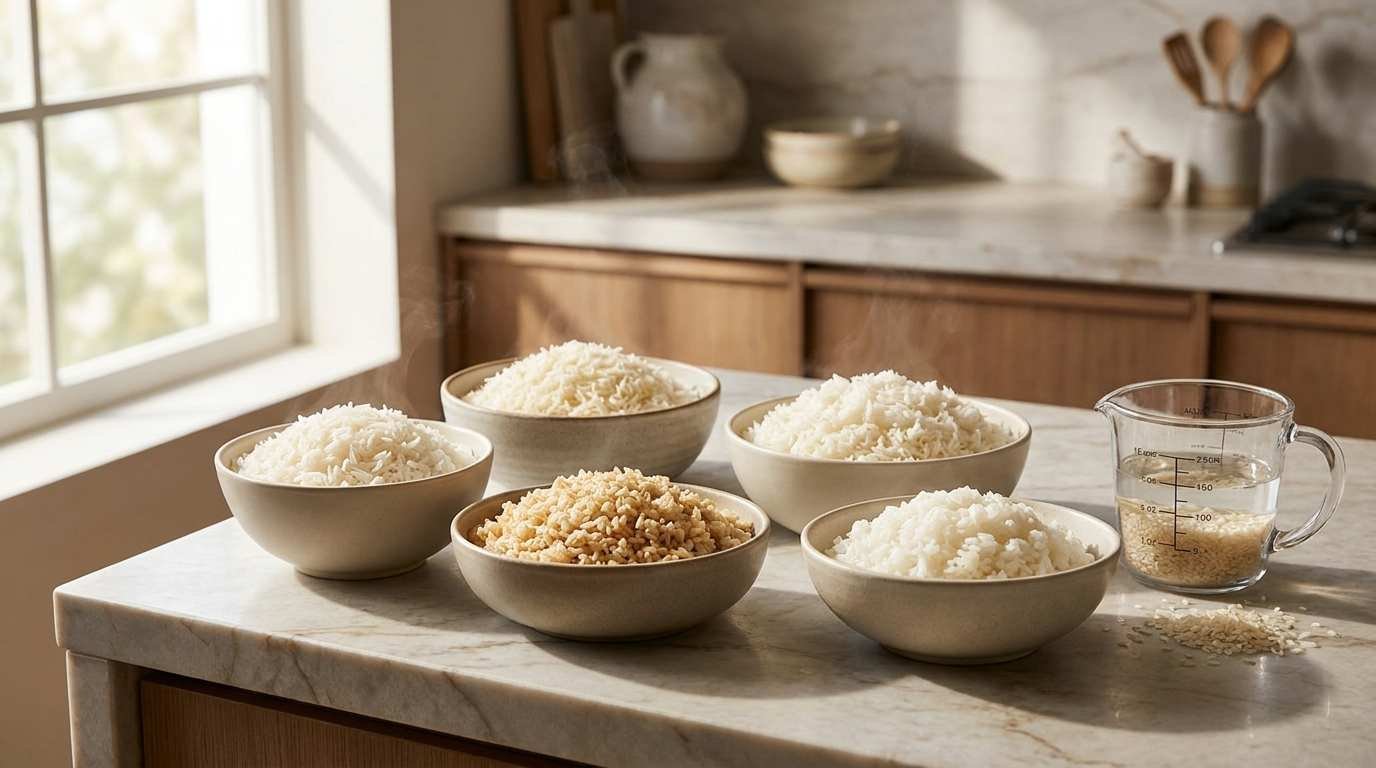

Rice becomes easy once you know the right rice-to-water ratio. For most varieties, the amount of water depends on the grain type, cooking method, and even how much moisture the rice has already absorbed. A simple 1:1.5 ratio may work beautifully for one rice, while another needs closer to 1:2.
The table below gives you a reliable starting point.
| Rice Type | Rice-to-Water Ratio* | Approx. Cooking Time | Result |
|---|---|---|---|
| Long-grain white rice | 1:1.5 | 15–20 min | Fluffy, separate grains |
| Basmati rice | 1:1.25–1.5 | 12–18 min | Light and fluffy |
| Jasmine rice | 1:1.25–1.5 | 12–18 min | Soft and fragrant |
| Short-grain white rice | 1:1.25–1.5 | 15–20 min | Soft, slightly sticky |
| Brown rice | 1:1.75–2 | 35–45 min | Firm and chewy |
| Wild rice | 1:3 | 40–50 min | Firm, chewy |
| Sushi rice | 1:1–1.25 | 15–20 min | Sticky and cohesive |
| Arborio rice | Varies | 20–30 min | Creamy |
| Parboiled rice | 1:1.5–2 | 20–30 min | Firm and separate |
*Ratios are useful starting points. Brand instructions and cooking equipment can change the amount needed.
Suggested Reads: Essential Cooking Ratios Every Home Cook Should Know
Table of Contents
What Is the Rice-to-Water Ratio?
The rice-to-water ratio tells you how much water to use for a measured amount of uncooked rice.
For example, a 1:1.5 rice-to-water ratio means:
- 1 cup rice
- 1.5 cups water
If you’re cooking 2 cups of rice at the same ratio, use 3 cups of water.
The ratio matters because rice absorbs water as it cooks. Too little water can leave the center hard. Too much can produce soft, wet rice.
The trick is matching the water level to the type of rice you’re cooking.
The Best Rice-to-Water Ratios by Rice Type
Different grains have different starch levels, sizes, textures, and cooking requirements. Here’s how to approach the most common varieties.
Long-Grain White Rice
For standard long-grain white rice, start with 1 cup rice to 1½ cups water when cooking on the stovetop.
The grains tend to remain separate after cooking, making this ratio useful for everyday side dishes, rice bowls, and meal prep.
For very dry climates or particularly thirsty rice, you may need a little more water.
Basmati Rice
Basmati rice generally needs less water than brown rice because the grains cook relatively quickly.
A good starting point is 1 cup basmati rice to 1¼–1½ cups water.
Rinsing basmati before cooking removes excess surface starch and helps produce a cleaner, more separated texture.
If you’ve soaked the rice for 20–30 minutes first, reduce the cooking water slightly.
Jasmine Rice
Jasmine rice is naturally softer and more aromatic than many long-grain varieties.
Start with approximately 1 cup rice to 1¼–1½ cups water.
For fluffy jasmine rice, rinse it, drain it well, and avoid stirring during cooking.
Jasmine rice can become soft quickly, so adding extra water “just to be safe” often works against you.
Short-Grain White Rice
Short-grain rice contains more starch and tends to stick together.
Use roughly 1 cup rice to 1¼–1½ cups water.
The exact amount depends on whether you want distinct grains or a softer, stickier texture.
For dishes where the rice needs to hold together, a little extra moisture can be useful.
Brown Rice
Brown rice retains its bran layer, which makes it slower to cook and gives it a firmer texture.
A common starting ratio is 1 cup brown rice to 1¾–2 cups water.
Expect a substantially longer cooking time than white rice.
If your brown rice repeatedly comes out chewy in the center, give it more cooking time before immediately adding a large amount of extra water.
Wild Rice
Wild rice behaves differently from ordinary rice because it’s technically the seed of an aquatic grass.
It needs considerably more water.
For a stovetop method, 1 cup wild rice to about 3 cups water is a useful starting point. You can drain the excess water after cooking, similar to pasta.
Sushi Rice
Sushi rice needs enough moisture to become cohesive while retaining enough structure to hold its shape.
A typical starting point is 1 cup sushi rice to about 1–1¼ cups water, depending on the rice and cooking method.
The rice is usually rinsed several times before cooking, then seasoned after cooking with sushi vinegar.
Arborio Rice
Arborio rice is used for risotto and follows a completely different approach.
You generally don’t cook it with one fixed amount of water and leave it alone.
Instead, warm stock or liquid is added gradually while the rice is stirred. This helps release starch and creates risotto’s characteristic creamy texture.
How to Measure Rice and Water Correctly
Your measuring method can change the result more than you might expect.
Use the same measuring system for both ingredients.
If you measure rice with a standard 240 ml measuring cup, measure the water using the same cup.
Don’t use a random coffee mug for the rice and a measuring jug for the water.
For repeatable results, weigh the rice with a kitchen scale and use a consistent water measurement.
Should You Measure Rice Before or After Rinsing?
Measure your rice before rinsing.
Then rinse it and drain it thoroughly.
Rice can retain a surprising amount of water after washing, particularly if it sits in a strainer for several minutes. If you’re trying to reproduce a recipe exactly, consistent draining matters.
Does Rinsing Rice Change the Water Ratio?
Yes, it can.
Rinsing removes loose surface starch and can also leave a small amount of water clinging to the grains.
For everyday stovetop rice, rinsing usually improves texture, especially with varieties such as basmati and jasmine.
After rinsing, let the rice drain well before adding your measured cooking water.
If you soak rice, the effect becomes even greater.
What Happens When You Soak Rice?
Soaking allows the grains to absorb some water before cooking begins.
That means soaked rice generally needs less cooking water and less cooking time than completely dry rice.
This is particularly useful with basmati rice.
The exact adjustment depends on how long you soak it, how thoroughly you drain it, and the cooking method you’re using.
How to Cook Rice on the Stovetop
A simple stovetop method works for many varieties.
Step 1: Measure the Rice
Measure the uncooked rice according to the number of servings you need.
As a rough guide, ½ cup uncooked rice per person works well for a generous side portion, although appetites vary.
Step 2: Rinse
Place the rice in a fine-mesh strainer or bowl.
Rinse under cool water until the water becomes noticeably clearer.
You don’t necessarily need perfectly transparent water.
Step 3: Add Water
Add the rice and the appropriate amount of water to a saucepan.
Add salt if desired.
Step 4: Bring It to a Boil
Bring the water to a boil over medium-high heat.
Once boiling, give the rice one gentle stir.
Step 5: Cover and Reduce the Heat
Place the lid on the pot and reduce the heat to low.
You want a gentle simmer.
Step 6: Cook Without Constant Stirring
Let the rice cook according to its variety.
Repeatedly lifting the lid releases steam, while frequent stirring can disturb the grains and release more starch.
Keep the lid closed as much as possible.
Step 7: Rest the Rice
Once the cooking time is finished, turn off the heat.
Leave the pot covered for 5–10 minutes.
This resting period gives the remaining moisture time to distribute through the grains.
Step 8: Fluff
Use a fork or rice paddle to gently separate the grains.
Avoid aggressively mashing or stirring the rice.
Why Does Rice Sometimes Turn Out Mushy?
Mushy rice usually comes from too much water, excessive cooking, or excessive stirring.
The easiest fix is to adjust one variable at a time.
If the rice is mushy but the flavor is fine, reduce the water slightly during your next batch.
If it’s mushy because the pot stayed on the heat too long, shorten the cooking period.
If the grains are breaking apart, stir less.
Your cooking pot matters, too. A wide saucepan loses water faster through evaporation than a narrow, tightly covered pot.
Why Is My Rice Hard or Crunchy?
Hard rice usually means the grains didn’t receive enough moisture or enough cooking time.
Possible causes include:
- Too little water
- Heat that was too high
- A lid that allowed too much steam to escape
- Insufficient cooking time
- An inaccurate rice-to-water ratio
- Rice that wasn’t allowed to finish steaming
If the rice is still hard and there’s visible water in the pot, simply continue cooking gently with the lid on.
If the pot is completely dry, add a small amount of hot water, cover it, and continue cooking.
Rice-to-Water Ratio for a Rice Cooker
Rice cookers simplify the process because they control temperature and cooking time automatically.
Still, the correct water amount depends on the cooker and rice variety.
Many rice cookers include a measuring cup and water markings inside the cooking bowl. Use the manufacturer’s instructions first.
The supplied cup may also differ from a standard U.S. measuring cup.
For example, a rice cooker’s cup is commonly smaller than a standard 240 ml kitchen cup.
That’s why mixing the supplied rice-cooker cup with unrelated water measurements can produce inconsistent results.
Does a Rice Cooker Need Less Water?
Sometimes.
Rice cookers generally lose less water through evaporation than an uncovered saucepan, so the same rice can require a different amount of water depending on the appliance.
Your rice cooker manual is the best starting point.
Once you’ve found a ratio you like, record it and repeat it.
Rice-to-Water Ratio for an Instant Pot
Pressure cooking changes the equation because very little water escapes as steam.
For many white rice varieties, a 1:1 rice-to-water ratio is a common starting point in pressure cookers.
Brown rice generally requires more water and a longer cooking time.
Your specific appliance, rice variety, rinsing method, and preferred texture still matter.
Pressure cooking is particularly useful when you want repeatable results, but the stovetop ratios above shouldn’t automatically be transferred to a pressure cooker.
Does Altitude Affect Rice Cooking?
Yes.
At higher elevations, water boils at a lower temperature.
That can affect cooking time and evaporation.
If rice consistently remains undercooked at altitude, you may need to extend the cooking time and adjust the amount of water slightly.
Start with a small adjustment rather than dramatically increasing the water.
Keep notes on the result. Rice is forgiving once you find the combination that works with your stove and cookware.
Does the Type of Pot Matter?
Absolutely.
A heavy saucepan with a tight-fitting lid behaves differently from a thin pot with a loose lid.
Three factors matter:
- Evaporation: A loose lid allows more moisture to escape.
- Heat distribution: Thin cookware can create hot spots.
- Pot size: A very wide pot can lose water faster than a smaller, deeper one.
If your rice recipe works perfectly in one pot and fails in another, the cookware may be part of the reason.
How Much Cooked Rice Does 1 Cup Make?
As a rough rule, 1 cup of uncooked white rice produces around 3 cups of cooked rice.
The exact yield varies by rice variety and cooking method.
Brown rice can also roughly triple in volume, although the final yield depends on how much water the grains absorb.
For meal planning, use cooked volume as an estimate rather than an exact measurement.
Common Rice-Cooking Mistakes
Using the Same Ratio for Every Rice
Rice varieties behave differently.
Brown rice needs more moisture and time than jasmine rice. Wild rice requires an entirely different method.
Adding Water Without Measuring
The “pour until it looks right” method can work after you’ve cooked the same rice dozens of times.
For a new rice, measuring is far more reliable.
Lifting the Lid Repeatedly
Every time you remove the lid, steam escapes.
That changes the cooking environment.
Stirring Constantly
Stirring can release starch and make rice stickier.
For fluffy rice, keep stirring to a minimum.
Skipping the Resting Period
Rice continues to settle and absorb moisture after the heat is turned off.
Give it a few minutes before fluffing.
A Simple Rice Ratio Cheat Sheet
Keep this table handy when you’re cooking.
| Rice | Starting Ratio | Main Tip |
|---|---|---|
| White long-grain | 1:1.5 | Keep covered |
| Basmati | 1:1.25–1.5 | Rinse and drain well |
| Jasmine | 1:1.25–1.5 | Avoid excess water |
| Short-grain | 1:1.25–1.5 | Expect stickier grains |
| Brown | 1:1.75–2 | Give it more time |
| Wild | 1:3 | Drain after cooking if needed |
| Sushi | 1:1–1.25 | Rinse thoroughly |
| Arborio | Added gradually | Stir with warm stock |
These are starting points rather than universal laws.
Rice brands can differ, and cooking equipment changes evaporation.
How to Adjust Your Ratio After the First Batch
Your first batch gives you useful information.
Rice too hard: Add a little more water or cooking time.
Rice too wet: Reduce the water slightly.
Rice cooked unevenly: Check your heat level and pot lid.
Rice sticks excessively: Rinse more thoroughly and reduce excess water.
Rice tastes good but lacks separate grains: Use slightly less water and avoid stirring.
Make only one change at a time.
If you change the rice, pot, water ratio, cooking time, and heat simultaneously, you won’t know which adjustment fixed the problem.
Key Takeaways
- 1:1.5 is a useful starting ratio for many long-grain white rice varieties.
- Basmati and jasmine rice often need around 1:1.25–1.5.
- Brown rice generally needs around 1:1.75–2.
- Wild rice commonly uses substantially more water, around 1:3.
- Rinsing can improve texture and changes how much water remains on the grains.
- Soaked rice generally requires less cooking water.
- Keep the lid closed during stovetop cooking.
- Rest cooked rice for 5–10 minutes before fluffing.
- Rice cookers and pressure cookers require different approaches.
- Adjust one variable at a time when troubleshooting.
Frequently Asked Questions
What is the best rice-to-water ratio?
For many varieties of white rice, 1 cup rice to 1½ cups water is a useful stovetop starting point. Basmati and jasmine rice often need less, while brown rice usually needs more.
Is 1 cup of rice equal to 2 cups of water?
It can be for some rice varieties and cooking methods, but 1:2 isn’t a universal rice-to-water ratio. White rice often needs less water, while brown rice may need close to that amount.
How much water do I need for 2 cups of rice?
It depends on the variety. Using a 1:1.5 ratio, 2 cups of rice require 3 cups of water. Always adjust the amount according to the rice type and cooking method.
Should I rinse rice before cooking?
Rinsing is useful for many varieties because it removes loose surface starch and can improve the finished texture. Basmati and jasmine rice are commonly rinsed before cooking.
Why does my rice come out sticky?
Sticky rice can result from the rice variety itself, excess water, or excessive stirring. Short-grain rice naturally becomes stickier than long-grain rice.
Should I soak rice before cooking?
Soaking can shorten cooking time and help some varieties cook more evenly. Basmati rice is commonly soaked, although the required water should then be adjusted.
Should I let rice rest after cooking?
Yes. Letting rice rest covered for about 5–10 minutes allows moisture to distribute through the grains and can improve the final texture.
Can I use the same ratio in a rice cooker and on the stove?
No single ratio works perfectly across both methods. Rice cookers retain moisture differently, so follow the appliance manufacturer’s markings and instructions when available.



Leave a Reply