
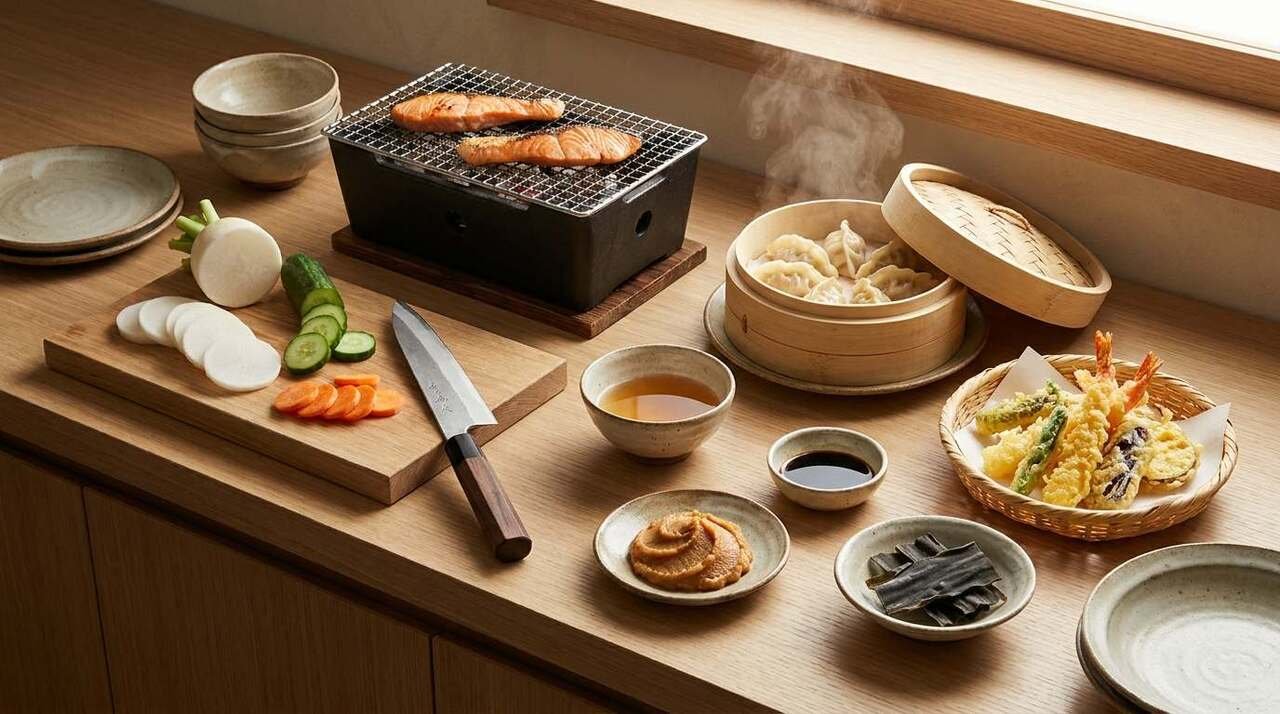

Japanese cuisine is built around a simple but powerful idea: bring out the natural character of each ingredient rather than hiding it beneath heavy sauces or excessive seasoning. That philosophy is reflected in the cooking techniques used throughout washoku, from precise knife work and gentle simmering to grilling, steaming, and deep-frying.
Traditional Japanese cooking recognizes five fundamental preparation methods: cutting or preparing ingredients raw, simmering, grilling, steaming, and deep-frying. These techniques give cooks different ways to develop flavor, texture, aroma, and appearance while respecting the ingredients themselves.
Learning these Japanese cooking techniques makes it much easier to prepare dishes such as miso soup, nimono, tempura, yakitori, grilled fish, chawan-mushi, sushi, and vegetable side dishes at home.
Suggested reads: Cooking for Large Groups: Easy Crowd Guide
Table of Contents
What Makes Japanese Cooking Techniques Different?
Japanese cooking places considerable emphasis on seasonality, freshness, balance, texture, and presentation. Instead of relying on complicated spice blends, cooks often use a relatively small collection of ingredients in carefully controlled proportions.
The goal is not necessarily to make food intensely seasoned. Instead, Japanese techniques are designed to reveal the ingredient’s inherent flavor while adding carefully selected layers of savory, sweet, salty, sour, and bitter notes.
A particularly important component is umami, the savory taste associated with ingredients such as kombu, bonito flakes, dried shiitake mushrooms, and other foods naturally rich in glutamate and related compounds.
This is why technique matters so much. A perfectly cut vegetable, properly prepared dashi, gently simmered root vegetable, or quickly fried piece of tempura can taste dramatically different from the same ingredient prepared carelessly.
The Five Fundamental Japanese Cooking Techniques
Traditional Japanese cuisine is often described through Goho, or five fundamental cooking methods:
- Nama — raw preparation and cutting
- Niru — simmering
- Yaku — grilling and cooking over direct or indirect heat
- Musu — steaming
- Ageru — deep-frying
These methods appear throughout Japanese cuisine and can be combined to create dishes with contrasting textures and flavors. Japan’s Ministry of Agriculture, Forestry and Fisheries identifies cutting, simmering, grilling, steaming, and deep-frying as the five basic techniques of Japanese cuisine.
Let’s examine each technique in detail.
1. Nama: Japanese Cutting and Raw Preparation
One of the most distinctive Japanese cooking techniques is the careful preparation of ingredients without conventional cooking.
This is particularly important in dishes such as sashimi, where the quality of the ingredient and the precision of the knife work become central to the final result.
Japanese culinary knife skills aren’t simply about making food look attractive. The direction, thickness, shape, and angle of each cut can influence texture and how the ingredient interacts with seasoning.
For example, fish for sashimi is cut according to its texture and structure. Vegetables can also be cut into decorative or functional shapes depending on the dish.
Why Knife Skills Matter in Japanese Cooking
Precise cutting helps create:
- Consistent cooking times
- Better texture
- Attractive presentation
- More effective seasoning
- Easier eating
- Greater appreciation of the ingredient
Japanese cuisine also includes decorative cutting techniques that transform vegetables into visually appealing garnishes.
When preparing ingredients, we should therefore think about the purpose of the cut, not simply its appearance.
2. Niru: The Art of Japanese Simmering
Niru means to simmer or cook ingredients in liquid. It is one of the most useful Japanese cooking techniques for home cooks.
Unlike aggressive boiling, simmering allows ingredients to cook gently while absorbing flavor from the cooking liquid.
A classic simmering base may include dashi, soy sauce, sake, mirin, or sugar, although the exact combination varies according to the dish.
Common examples include nimono, a broad category of Japanese simmered dishes.
Vegetables, tofu, seafood, meat, and root vegetables can all benefit from this method.
How to Simmer Japanese Food Properly
For better results:
- Prepare ingredients in similarly sized pieces.
- Use an appropriate cooking liquid.
- Bring the liquid to the required temperature.
- Reduce the heat rather than maintaining a vigorous boil.
- Cook until the ingredient reaches the desired tenderness.
- Allow sufficient time for the flavors to develop.
The objective is usually to produce food that remains recognizable in shape while becoming tender and deeply seasoned.
Chikuzen-ni, for example, combines ingredients such as chicken and vegetables in a flavorful simmering process. Similar simmered dishes have long been associated with everyday Japanese home cooking.
3. Yaku: Japanese Grilling and Direct-Heat Cooking
Yaku encompasses cooking with direct or indirect heat. It includes grilling, roasting, and several forms of pan cooking.
Japanese grilling is particularly effective for fish, chicken, vegetables, tofu, and skewered foods.
Popular examples include:
- Shioyaki — salt-grilled foods
- Yakitori — grilled chicken skewers
- Kushiyaki — grilled foods cooked on skewers
- Teriyaki — foods cooked with a sweet-savory glaze
Shioyaki: Simple Salt Grilling
Shioyaki demonstrates how Japanese cuisine can create excellent flavor with remarkably few ingredients.
Fish is seasoned primarily with salt and then grilled. Because there is no complicated sauce covering the ingredient, the quality of the fish and control of the heat become extremely important.
The technique emphasizes the natural flavor of the ingredient while creating a beautifully cooked exterior.
Controlling Heat When Grilling
Japanese-style grilling rewards patience.
Excessive heat can burn the surface before the center is properly cooked. Moderate, controlled heat allows the exterior to develop desirable color while maintaining moisture inside.
For home cooking, a grill, broiler, cast-iron pan, or suitable stovetop grill can reproduce aspects of this technique.
4. Musu: Japanese Steaming Technique
Musu means steaming.
Steaming cooks food through hot water vapor rather than placing the ingredient directly into boiling water or cooking oil.
This technique is especially useful when we want to preserve a delicate texture.
Common ingredients include:
- Fish
- Chicken
- Eggs
- Tofu
- Mushrooms
- Leafy vegetables
- Root vegetables
One famous example is chawan-mushi, a delicate savory Japanese egg custard.
The Secret to Better Japanese Steaming
The steamer should already be producing sufficient steam before the food is placed inside.
A properly heated steamer helps the food cook consistently. Gentle steaming is particularly important for delicate preparations because excessive heat can produce undesirable textures.
Steaming also allows subtle ingredients to remain the focus rather than being overwhelmed by oil or strong seasonings.
5. Ageru: Japanese Deep-Frying
Ageru refers to deep-frying.
Japanese cuisine has developed several celebrated fried dishes, with tempura being one of the best-known examples.
Deep-frying provides rapid heat transfer and can create a crisp exterior while keeping the interior moist.
The Japanese Ministry of Agriculture describes deep-frying as a high-temperature cooking method that can cook ingredients quickly while helping preserve their flavor.
How Japanese Tempura Differs
Good tempura is not simply food covered in batter and fried.
The batter, oil temperature, ingredient preparation, and frying time all matter.
The objective is a light, crisp coating rather than a thick, heavy crust.
Vegetables, seafood, mushrooms, and other ingredients can all be prepared as tempura.
The most important lesson is to avoid overcrowding the cooking vessel. Adding too much food at once can reduce the oil temperature and produce greasy rather than crisp results.
Dashi: The Foundation of Japanese Flavor
Although dashi is not one of the five cooking methods, understanding it is essential for mastering Japanese cuisine.
Dashi is a Japanese stock used as a flavor foundation for soups, simmered dishes, sauces, and many other preparations.
Common ingredients include:
- Kombu
- Katsuobushi
- Dried shiitake mushrooms
- Dried small fish
Different ingredients produce different flavor profiles.
Kombu is particularly associated with glutamate-based umami, while bonito flakes provide another important source of savory depth. Dried shiitake mushrooms are another traditional source of umami.
Unlike many Western stocks that may require hours of simmering, several forms of Japanese dashi can be prepared relatively quickly.
This makes dashi one of the most practical techniques to learn when beginning Japanese cooking.
Japanese Seasoning Techniques: Balance Over Intensity
Japanese cooking frequently relies on a small group of fermented and savory seasonings.
Important ingredients include:
- Soy sauce
- Miso
- Mirin
- Sake
- Rice vinegar
- Salt
- Dashi
The objective is not to use every seasoning in every recipe.
Instead, we use each ingredient strategically.
Soy sauce can provide saltiness and savory depth. Mirin contributes sweetness and gloss. Miso provides fermented complexity, while rice vinegar introduces acidity.
When combined with dashi, these ingredients can create remarkable depth without requiring large quantities.
Ohitashi: A Simple Japanese Technique Worth Learning
Ohitashi is a useful example of how Japanese cooking can transform a simple vegetable into an elegant side dish.
Vegetables are cooked and then immersed in seasoned liquid.
Leafy greens such as spinach or komatsuna are particularly suitable.
The technique demonstrates an important principle: good Japanese cooking does not require complicated recipes.
Instead, careful cooking, appropriate seasoning, and attention to texture can make a simple ingredient memorable.
Japanese Cooking and the Importance of Seasonality
Seasonality is central to traditional Japanese cuisine.
Rather than treating ingredients as interchangeable throughout the year, Japanese cooking traditionally celebrates foods when they are at their seasonal best.
That philosophy affects everything from ingredient selection to cooking method and presentation.
A delicate vegetable may be steamed to preserve its character. Fresh fish may be grilled simply with salt. Root vegetables may be simmered slowly in dashi.
The technique is selected according to the ingredient.
This is one of the most valuable lessons we can take from Japanese cuisine: the cooking method should serve the food rather than overpower it.
How to Master Japanese Cooking Techniques at Home
We don’t need a professional Japanese kitchen to begin.
Start with a small collection of versatile tools:
- A sharp chef’s knife
- A cutting board
- A saucepan
- A frying pan
- A fine-mesh strainer
- A steamer basket
- Measuring spoons
- A rice cooker or heavy saucepan
Then practice one technique at a time.
Begin With Simmering
Simmering is forgiving and practical. Try tofu, daikon, carrots, mushrooms, or chicken.
Practice Grilling
Start with salmon, mackerel, chicken thighs, mushrooms, or eggplant.
Learn Steaming
Try vegetables, fish, or chawan-mushi.
Make Simple Dashi
Once we understand dashi, many Japanese recipes become easier to understand because we can recognize how the underlying savory flavor is constructed.
Improve Knife Skills
Consistent cutting improves both cooking and presentation.
Try Tempura Last
Deep-frying requires greater attention to temperature and timing, so it makes sense to practice the other methods first.
Common Mistakes When Learning Japanese Cooking
One common mistake is using too much seasoning.
Japanese cuisine often depends on restraint. Adding excessive soy sauce, sugar, or miso can cover the natural flavors that the technique is supposed to highlight.
Another mistake is boiling everything aggressively.
Gentle cooking is essential for many Japanese preparations.
We should also avoid ignoring texture. Japanese cuisine pays close attention to the contrast between crisp, tender, chewy, soft, and silky components.
Finally, presentation should not be treated as an afterthought. The traditional Japanese approach considers food’s appearance, serving vessel, color, and arrangement as part of the overall dining experience.
A Practical Japanese Cooking Technique Cheat Sheet
| Technique | Japanese Term | Best Uses |
|---|---|---|
| Raw preparation/cutting | Nama | Sashimi, vegetables, garnishes |
| Simmering | Niru | Vegetables, tofu, meat, fish |
| Grilling | Yaku | Fish, chicken, vegetables |
| Steaming | Musu | Fish, eggs, tofu, vegetables |
| Deep-frying | Ageru | Tempura, fried foods |
| Boiling | Yuderu | Noodles and vegetables |
| Dressing | Aeru | Vegetables, seafood, salads |
| Pickling | Tsukeru | Daikon, cucumber, vegetables |
These methods can be combined rather than treated as isolated techniques. Japanese cuisine uses a broad range of preparations to create balanced meals with contrasting flavors and textures.
The Core Philosophy Behind Japanese Cooking
The most important lesson isn’t a particular recipe.
It is the relationship between ingredient, technique, seasoning, texture, and presentation.
Japanese cooking demonstrates that excellent food does not always require complicated preparation. A piece of fresh fish can become an exceptional dish through careful cutting or grilling. A simple vegetable can become deeply satisfying through simmering in dashi. A handful of ingredients can produce remarkable depth when umami is used intelligently.
Traditional washoku is also closely associated with appreciation of seasonality and the natural qualities of ingredients. UNESCO recognition of washoku reflects the cultural importance of these traditions and their relationship with seasonal food and presentation.
By mastering cutting, simmering, grilling, steaming, and deep-frying, we build the foundation for preparing a remarkably broad range of Japanese dishes.
The techniques may appear simple.
But mastering their details—heat control, timing, knife work, seasoning, texture, and presentation—is what turns simple ingredients into truly memorable Japanese food.


Leave a Reply