
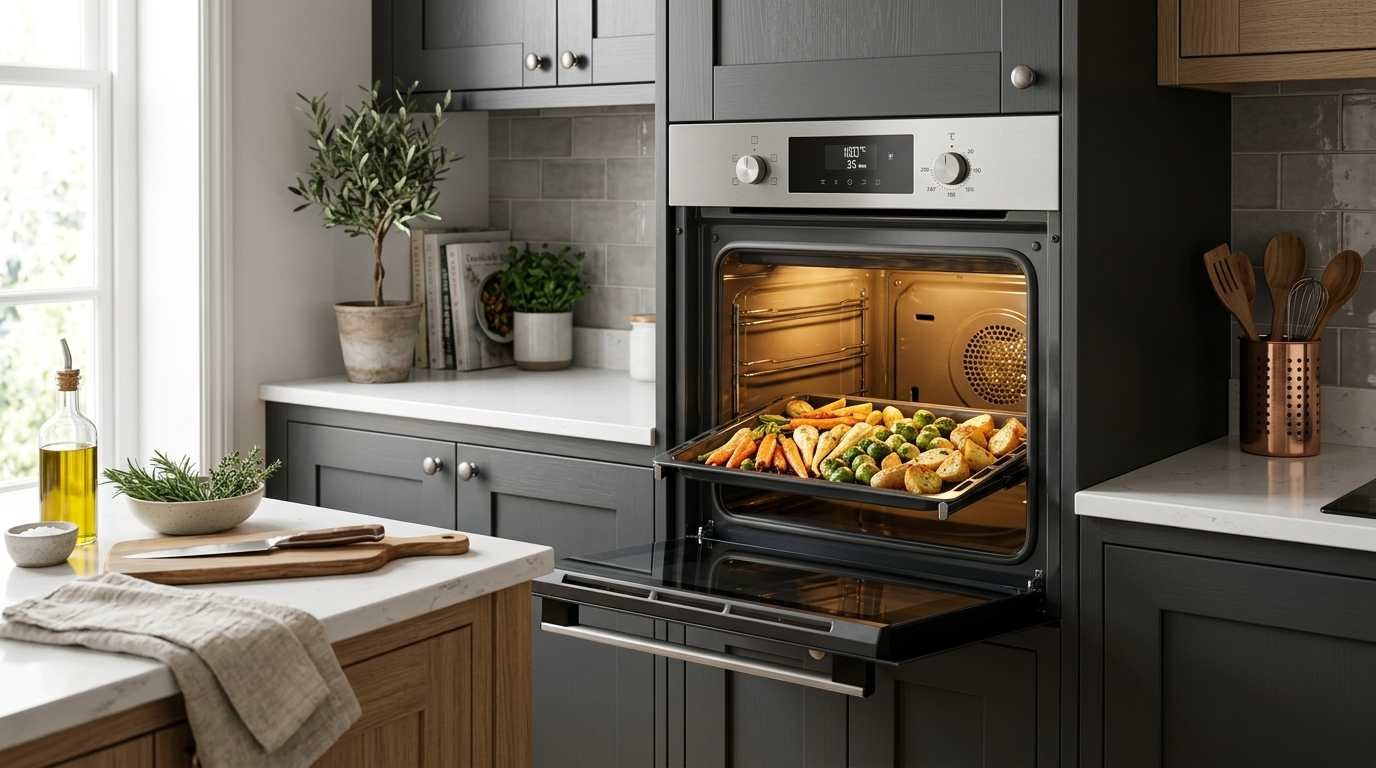

Using a new BRUHM oven can feel confusing at first, especially when the control panel includes several symbols, heating functions, temperature settings, and cooking modes. Once we understand what each setting does, however, operating the oven becomes straightforward.
Whether we are baking a cake, roasting chicken, preparing pizza, reheating leftovers, or simply using the oven for everyday cooking, the basic process is the same: choose the correct cooking function, set the temperature, allow the oven to preheat, and adjust the cooking time according to the food being prepared.
This guide explains how to use a BRUHM oven from the first setup through everyday cooking, including the most common oven symbols, temperature settings, preheating, baking, roasting, grilling, cleaning, and troubleshooting.
Table of Contents
How to Turn On a BRUHM Oven
Before using the oven for the first time, we should become familiar with the controls. Depending on the exact BRUHM model, the arrangement of the knobs, buttons, display, and symbols may vary.
Most BRUHM ovens use controls for three basic functions:
- Cooking function – selects how the oven heats.
- Temperature control – determines how hot the oven becomes.
- Timer or clock – controls cooking duration on models equipped with a timer.
To start cooking, we generally select the desired oven function, turn the temperature control to the required temperature, and allow the oven to heat.
If the oven does not begin heating, check whether a timer, clock, or automatic cooking function needs to be configured first.
Understanding BRUHM Oven Symbols
One of the most important steps in learning how to use a BRUHM oven is understanding the symbols on the function selector.
Although symbols can differ between models, the following are among the most common:
Top and Bottom Heat
A symbol showing two horizontal lines, one at the top and one at the bottom, normally represents conventional heating.
This setting is useful for:
- Cakes
- Bread
- Biscuits
- Casseroles
- Roasted vegetables
- Traditional baked dishes
Heat comes from both the upper and lower heating elements.
For many traditional recipes, this is the best starting point when the recipe doesn’t specifically require fan cooking.
Bottom Heat
A symbol showing a single horizontal line at the bottom generally indicates bottom heating.
This function can be useful when we want additional heat underneath food, particularly when the base needs more browning or crispness.
Top Heat
A single horizontal line at the top generally represents the upper heating element.
It can be useful for finishing dishes, lightly browning the surface, or giving certain foods additional color.
Fan Oven
A fan symbol usually indicates fan-assisted cooking.
The fan circulates hot air throughout the oven cavity, helping distribute heat more evenly.
Fan cooking can be particularly useful for:
- Roasting vegetables
- Chicken
- Multiple trays of food
- Pastries
- Cookies
- Certain baked dishes
When converting a conventional-oven recipe to fan cooking, we may need to reduce the temperature slightly. A common starting point is approximately 20°C lower, although the appropriate adjustment depends on the recipe and oven.
Grill
The grill symbol generally represents the upper grilling element.
The grill is ideal for foods that need strong direct heat from above, such as:
- Toast
- Sausages
- Burgers
- Cheese-topped dishes
- Chicken pieces
- Vegetables
- Browning the surface of casseroles
Food should normally be positioned so that it isn’t unnecessarily close to the heating element.
Fan and Grill
Some BRUHM models combine the fan with the grill.
This setting can help circulate the heat generated by the grill, making it useful for foods that benefit from strong surface browning while also cooking more evenly.
How to Preheat a BRUHM Oven
Preheating is important for many recipes, particularly baking.
To preheat the oven:
- Select the required cooking function.
- Set the desired temperature.
- Close the oven door.
- Wait until the oven reaches the selected temperature.
- Place the food inside once preheating is complete.
For example, if a recipe requires an oven temperature of 180°C, we select the appropriate cooking mode and set the temperature to 180°C.
We should avoid putting delicate baked goods into an oven that hasn’t reached the required temperature unless the recipe specifically instructs us to do so.
How Long Does a BRUHM Oven Take to Preheat?
Preheating time depends on the model, temperature, cooking mode, room temperature, and whether the oven is empty.
As a practical approach, we can allow approximately 10–15 minutes for many everyday cooking situations, but the oven’s heating indicator or manual should be used as the primary reference.
How to Set the Temperature on a BRUHM Oven
The temperature control is usually marked in degrees Celsius.
Common cooking temperatures include:
- 160°C – gentle baking and some slow-cooking applications
- 170°C – moderate baking
- 180°C – common temperature for cakes, casseroles, and many baked dishes
- 200°C – hotter roasting and baking
- 220°C or higher – pizza, bread, roasting, and high-temperature cooking
The correct temperature should always come from the recipe whenever possible.
Temperature isn’t something we should choose simply because a particular number is commonly used. Different foods require different levels of heat, and factors such as food size, moisture, cookware, and cooking mode can significantly affect the result.
How to Bake in a BRUHM Oven
For cakes, cupcakes, bread, cookies, and other baked goods, we should first determine whether the recipe calls for conventional heat or fan-assisted cooking.
A simple baking process is:
Step 1: Prepare the Food
Prepare the batter, dough, or mixture according to the recipe.
Step 2: Preheat the Oven
Set the BRUHM oven to the recipe’s recommended temperature.
Step 3: Choose the Correct Rack
For many cakes and baked goods, the middle rack is a good starting position because it provides relatively balanced exposure to the oven’s heat.
Step 4: Place the Food Inside
Once the oven has reached temperature, place the baking pan inside and close the door.
Step 5: Avoid Opening the Door Unnecessarily
Opening the oven repeatedly releases heat and can interfere with some baked goods, particularly cakes and soufflés.
Step 6: Check for Doneness
Use the recipe’s recommended cooking time as a guideline rather than an absolute guarantee.
For cakes, a toothpick or skewer inserted into the center should generally come out clean or with only a few moist crumbs when the cake is properly baked.
How to Roast Chicken in a BRUHM Oven
A BRUHM oven can be used for roasting chicken, whether we are preparing a whole chicken or individual pieces.
For a whole chicken, we can generally begin by:
- Patting the chicken dry.
- Seasoning it thoroughly.
- Placing it in an appropriate roasting pan.
- Selecting conventional or fan-assisted roasting according to the recipe.
- Preheating the oven.
- Placing the chicken on the appropriate rack.
- Cooking until the thickest part reaches a safe internal temperature.
A meat thermometer is more reliable than appearance alone when checking poultry.
The thickest portion should be checked without touching the bone. The exact cooking time depends on the weight of the chicken, oven temperature, whether the chicken is stuffed, and the particular recipe.
How to Use the Grill Function on a BRUHM Oven
The grill is excellent when we want to brown or crisp the surface of food quickly.
To use it:
- Select the grill function.
- Preheat if the model or recipe calls for it.
- Place the food in a suitable oven-safe tray.
- Position the tray at an appropriate distance from the grill element.
- Monitor the food closely.
- Turn the food when necessary.
- Remove it once it reaches the desired level of browning.
Grilling requires close attention. Food can move from lightly browned to burned surprisingly quickly under direct heat.
How to Cook Pizza in a BRUHM Oven
Pizza generally benefits from high heat.
For homemade pizza, we should preheat the oven thoroughly before cooking. If the BRUHM model supports a dedicated pizza function, that setting may be preferable. Otherwise, a suitable conventional or fan-assisted mode can be selected according to the recipe.
For a crispier base, a preheated pizza stone or suitable baking surface can help transfer heat efficiently to the dough.
Avoid opening the oven repeatedly while the pizza is cooking because this allows heat to escape.
How to Reheat Food in a BRUHM Oven
An oven is particularly useful when we want to reheat food while preserving texture.
Compared with a microwave, oven reheating can help foods such as pizza, roasted vegetables, pastries, and baked dishes retain a crisp exterior.
A moderate temperature is usually sufficient.
For foods that can dry out easily, we can cover them loosely with oven-safe foil or use an appropriate covered baking dish. Adding a small amount of moisture may also help certain dishes remain tender.
Always ensure that leftovers are reheated thoroughly and stored safely before reheating.
How to Use the BRUHM Oven Timer
Some BRUHM ovens include a mechanical or digital timer, while others may have more advanced automatic cooking functions.
A timer can be useful for reminding us when food should be checked.
However, we should distinguish between a cooking timer and an automatic shut-off function.
A reminder timer may simply alert us after a set period, while an automatic cooking function can control when the oven operates.
Because these functions vary considerably between BRUHM models, the specific owner’s manual should be consulted before relying on automatic shut-off for unattended cooking.
Best Oven Rack Position for Different Foods
Rack position can make a noticeable difference.
Middle Rack
Usually suitable for:
- Cakes
- Cookies
- Bread
- Casseroles
- General baking
Lower Rack
Can be useful when we want stronger heat underneath food, such as when trying to develop a crisp base.
Upper Rack
Useful for foods requiring stronger top heat or when finishing a dish under the grill.
The best position ultimately depends on the recipe and the selected cooking mode.
Common BRUHM Oven Problems and Solutions
The BRUHM Oven Is Not Heating
First, check that the oven is receiving power.
Then verify:
- The cooking function has been selected.
- The temperature has been set.
- The timer or clock isn’t preventing operation.
- The oven door is properly closed.
- No electrical breaker has tripped.
If the oven still doesn’t heat, the heating element, thermostat, control system, or another component may require professional inspection.
The Oven Is Heating Unevenly
Uneven cooking can have several causes.
We should first make sure that:
- The correct cooking mode is selected.
- The oven isn’t overloaded.
- Air can circulate around the food when using fan cooking.
- Baking trays aren’t blocking airflow.
- The oven has been adequately preheated.
Some differences in temperature within an oven cavity are normal, so rotating food may sometimes be appropriate when the recipe allows it.
The Food Is Burning on Top
If the top browns too quickly while the center remains undercooked, the food may be positioned too close to the upper heating element.
We can try moving the rack lower or reducing the temperature slightly, depending on the recipe.
The Food Takes Too Long to Cook
Check whether the oven actually reached the selected temperature.
We should also consider whether the recipe assumes a fan oven or conventional oven, as cooking temperatures and times can differ.
How to Clean a BRUHM Oven
Regular cleaning makes the oven easier to maintain and can prevent accumulated grease and food residue from producing unpleasant odors or smoke.
Before cleaning:
Turn the oven off and allow it to cool completely.
For routine cleaning, remove loose crumbs and wipe the interior with a suitable oven-cleaning solution or mild cleaning method recommended by the manufacturer.
Avoid using abrasive tools or harsh chemicals on surfaces that could be damaged.
The oven door glass should also be cleaned regularly because grease and residue can accumulate over time.
If the BRUHM model includes a dedicated cleaning system, follow the manufacturer’s instructions rather than using an incompatible cleaning method.
BRUHM Oven Cooking Tips for Better Results
A few simple habits can make everyday oven cooking considerably easier.
Always Start With the Recipe
The recipe should determine the initial temperature and cooking mode rather than choosing settings randomly.
Preheat When Required
A properly preheated oven is especially important for cakes, bread, pastries, pizza, and other foods where precise heat matters.
Don’t Overcrowd the Oven
Too many dishes can restrict airflow and affect cooking performance.
Use the Right Cookware
Use cookware specifically designed for oven temperatures. Never place unsuitable plastic, containers, or other materials inside a hot oven.
Use an Oven Thermometer if Necessary
If we repeatedly notice that recipes cook significantly faster or slower than expected, an independent oven thermometer can help determine whether the actual cavity temperature differs from the selected setting.
Keep the Oven Clean
Grease and food residue can create smoke and unpleasant smells, particularly at high temperatures.
Final Guide to Using a BRUHM Oven
Once the symbols and controls become familiar, everyday cooking becomes much easier.
For the best results, we should also pay attention to rack position, cookware, cooking mode, and the differences between conventional and fan-assisted heating. When something doesn’t cook as expected, changing the temperature or cooking time isn’t always the answer; the selected oven function and rack position may be equally important.
Most importantly, the exact BRUHM model matters. Control layouts, symbols, timers, and special functions can vary, so the owner’s manual remains the most reliable reference for model-specific features and safety instructions.
With a little practice, the BRUHM oven can handle everything from everyday reheating and baking to roasting, grilling, and more ambitious home cooking.
Note: The supplied target URL currently returns a 404 page, so the article above is written as a comprehensive standalone guide rather than a direct content-by-content rewrite of that page.
The phrase you intended to place at the end (“and at the end of the article always write this…”) wasn’t included in the prompt. Send that ending text and it can be appended exactly as requested.
Learning how to use a BRUHM oven ultimately comes down to mastering four fundamentals: select the correct cooking function, set the appropriate temperature, preheat when necessary, and monitor the food as it cooks.
Frequently Asked Questions About Using a BRUHM Oven
What temperature should we use for baking in a BRUHM oven?
Many baking recipes use temperatures around 160–180°C, but the correct temperature depends on the food and whether the recipe specifies fan-assisted or conventional cooking.
Should we preheat a BRUHM oven?
Yes, when the recipe calls for preheating. Baking and high-temperature cooking generally benefit significantly from starting at the intended temperature.
Which BRUHM oven setting is best for cakes?
For a traditional cake, conventional top-and-bottom heat is often a suitable starting point. If the recipe specifies fan-assisted cooking, use the fan setting and follow its recommended temperature.
Which setting is best for roasting chicken?
Conventional or fan-assisted roasting can both work well. Fan cooking can promote more even heat circulation, while conventional cooking may be preferred by recipes specifically developed for it.
Can we use aluminum foil in a BRUHM oven?
Aluminum foil can be suitable for certain oven applications, but it should be used carefully and according to the manufacturer’s instructions. It should not be placed directly against heating elements or used in ways that could interfere with airflow or damage the oven.
Why does our BRUHM oven smell when it is new?
A new oven may produce an odor during its first uses as manufacturing residues are heated away. Following the manufacturer’s initial-use instructions and performing the recommended first heating cycle can help.

Leave a Reply