
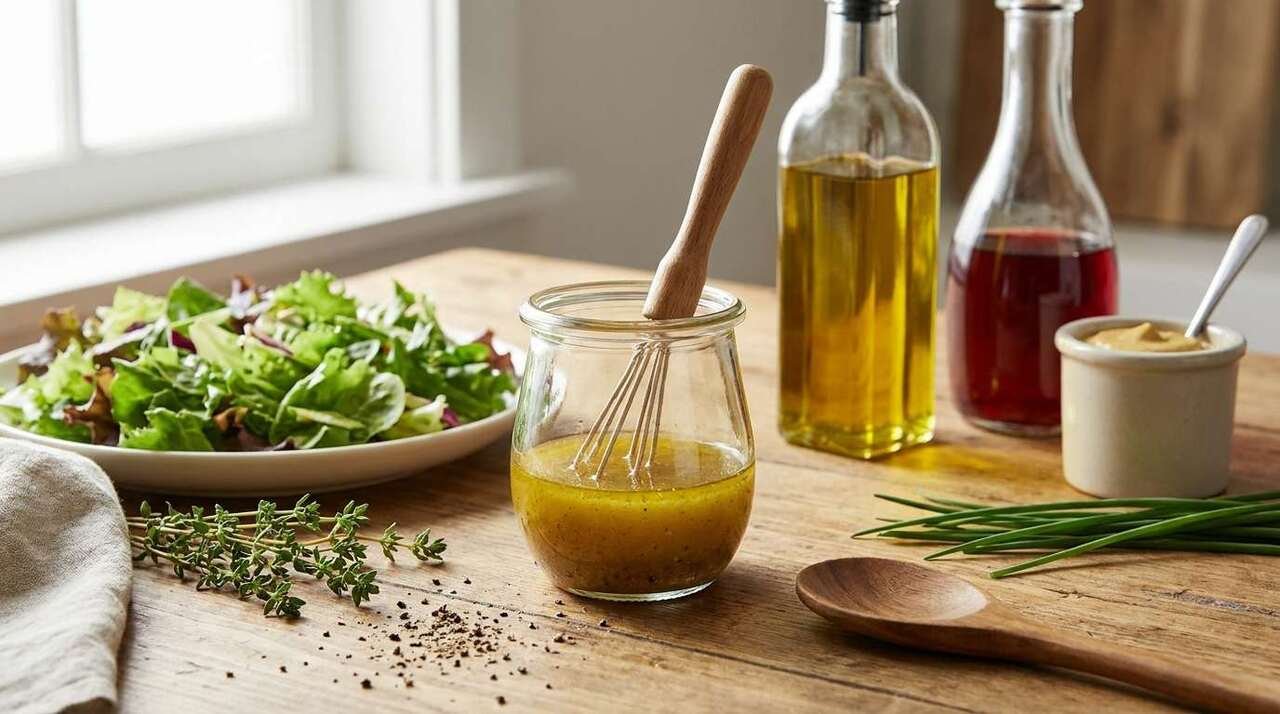

A basic vinaigrette ratio gives you an easy formula for making homemade salad dressing without relying on a complicated recipe. The classic starting point is 3 parts oil to 1 part vinegar, although you can adjust the balance depending on how acidic, creamy, sweet, or mild you want your vinaigrette to taste.
Once you understand this simple ratio, you can make a fresh dressing in minutes using ingredients you already have in your kitchen.
The beauty of vinaigrette is its flexibility. Olive oil and red wine vinegar create a classic combination, while lemon juice, balsamic vinegar, Dijon mustard, honey, garlic, herbs, and different oils can completely change the finished dressing.
This guide explains the basic vinaigrette ratio, how to adjust it, how to emulsify the dressing, common mistakes to avoid, and several easy variations you can use for salads, roasted vegetables, grain bowls, and more.
Table of Contents
What Is the Basic Vinaigrette Ratio?
The traditional basic vinaigrette ratio is 3 parts oil to 1 part vinegar.
For example:
| Oil | Vinegar | Makes |
|---|---|---|
| 3 tablespoons | 1 tablespoon | Small batch |
| 6 tablespoons | 2 tablespoons | Medium batch |
| 9 tablespoons | 3 tablespoons | Larger batch |
| ¾ cup | ¼ cup | About 1 cup |
The 3:1 formula is a useful starting point rather than a strict rule. Some vinegars are sharper than others, and personal preference matters.
If you prefer a brighter, more acidic dressing, increase the vinegar. If you want a smoother and milder vinaigrette, use a little more oil.
The basic formula
3 parts oil + 1 part acid = basic vinaigrette
The oil provides richness and body, while the acid supplies brightness and acidity.
You can then add other ingredients for flavor and balance.
A simple version might contain:
- 3 tablespoons extra-virgin olive oil
- 1 tablespoon red wine vinegar
- ½ teaspoon Dijon mustard
- ¼ teaspoon salt
- Freshly ground black pepper
Whisk everything together, taste, and adjust.
Why the 3:1 Vinaigrette Ratio Works
Oil and vinegar have very different properties. Oil is rich and fatty, while vinegar is acidic and sharp. Using too much vinegar can make a dressing harsh, while using too much oil can make it taste flat or heavy.
The traditional 3:1 ratio creates a useful middle ground.
However, the ideal balance depends on the ingredients you’re using.
For example, balsamic vinegar can taste sweeter and rounder than a sharp white vinegar. Lemon juice can provide a fresh, bright acidity. Champagne vinegar tends to be delicate, while some red wine vinegars have a more pronounced tang.
That’s why the best approach is to use the ratio as a starting point and then taste and adjust.
Basic Vinaigrette Ingredients
A simple vinaigrette doesn’t require a long ingredient list.
1. Oil
Oil is the main ingredient and provides richness, texture, and mouthfeel.
Good options include:
- Extra-virgin olive oil
- Avocado oil
- Grapeseed oil
- Canola oil
- Walnut oil
- Sesame oil
- Hazelnut oil
For a classic Mediterranean-style vinaigrette, extra-virgin olive oil is an excellent choice.
For delicate salads, a neutral oil can allow the other ingredients to stand out.
2. Vinegar or Other Acid
The acid provides the characteristic tang of vinaigrette.
Popular choices include:
- Red wine vinegar
- White wine vinegar
- Apple cider vinegar
- Champagne vinegar
- Balsamic vinegar
- Sherry vinegar
- Rice vinegar
- Fresh lemon juice
- Fresh lime juice
You don’t have to use vinegar. Citrus juice can work beautifully, especially with green salads, seafood, chicken, and Mediterranean-inspired dishes.
3. Salt
Salt helps bring the flavors together.
Start with a small amount, whisk it into the dressing, and taste. You can always add more.
4. Black Pepper
Freshly ground black pepper adds subtle heat and aroma.
It’s particularly good in simple olive oil and vinegar dressings.
5. Dijon Mustard
Dijon mustard isn’t required for a basic vinaigrette, but it’s one of the most useful additions.
It contributes flavor and helps the oil and acid stay mixed together longer.
6. Sweetener
A small amount of honey, maple syrup, or another sweetener can soften sharp acidity.
This is especially helpful when using strongly acidic vinegar.
Use sweetness carefully. The goal is usually balance rather than making the vinaigrette taste sweet.
How to Make a Basic Vinaigrette
Making homemade vinaigrette takes only a few minutes.
Step 1: Combine the Acid and Seasonings
Add your vinegar or lemon juice to a bowl or jar.
Add salt, pepper, Dijon mustard, herbs, garlic, or other seasonings.
Mix well.
Step 2: Add the Oil
Slowly drizzle in the oil while whisking continuously.
This helps distribute the oil through the acidic ingredients.
Step 3: Taste
Taste the vinaigrette before serving.
Ask yourself:
- Is it too acidic?
- Is it too oily?
- Does it need more salt?
- Does it need sweetness?
- Is the flavor strong enough?
Adjust one ingredient at a time.
Step 4: Toss With Your Salad
Add the vinaigrette gradually rather than pouring the entire batch over the salad.
Toss the greens gently and add more dressing if necessary.
This prevents an otherwise great salad from becoming soggy or overdressed.
How to Adjust the Basic Vinaigrette Ratio
The 3:1 ratio is a starting point, not a rule you have to follow forever.
For a More Acidic Vinaigrette
Try moving toward:
2 parts oil to 1 part acid
This produces a brighter, sharper dressing.
It’s particularly useful for hearty greens that can handle stronger flavors.
For a Milder Vinaigrette
Try:
4 parts oil to 1 part acid
This creates a softer dressing with less acidity.
It’s useful when serving delicate greens or when the other salad ingredients are already strongly flavored.
For a Sweet Vinaigrette
Keep the basic oil-to-acid ratio but add a small amount of:
- Honey
- Maple syrup
- Fruit preserves
- Orange juice
Taste as you go because sweet ingredients can quickly change the balance.
Basic Vinaigrette Ratio Cheat Sheet
| Style | Oil | Acid | Best For |
| Classic | 3 parts | 1 part | Everyday salads |
| Tangy | 2 parts | 1 part | Hearty greens |
| Mild | 4 parts | 1 part | Delicate salads |
| Sweet-tangy | 3 parts | 1 part + sweetener | Spinach or fruit salads |
| Citrus | 3 parts | 1 part citrus | Chicken and seafood salads |
These ratios are starting points. The final flavor will depend on the specific oil, vinegar, seasonings, and other ingredients you choose.
The Best Oil for Homemade Vinaigrette
For an everyday vinaigrette, extra-virgin olive oil is one of the easiest choices.
It provides a fruity, peppery flavor that works particularly well with:
- Green salads
- Tomatoes
- Cucumbers
- Feta
- Olives
- Roasted vegetables
- Beans
- Grains
However, don’t feel limited to olive oil.
A neutral oil can create a lighter-tasting dressing, while nut oils can add a more distinctive flavor.
If you’re using an expensive flavored oil, consider pairing it with a relatively mild vinegar so neither ingredient overwhelms the other.
The Best Vinegar for Vinaigrette
Different vinegars produce dramatically different dressings.
Red Wine Vinegar
Red wine vinegar is bold, tangy, and versatile. It’s particularly good with Mediterranean-style salads.
White Wine Vinegar
White wine vinegar is lighter and more delicate than red wine vinegar.
Apple Cider Vinegar
Apple cider vinegar brings a fruity acidity and works well with fall salads, cabbage, apples, and roasted vegetables.
Balsamic Vinegar
Balsamic vinegar provides deeper, sweeter flavors and works beautifully with tomatoes, strawberries, mozzarella, and leafy greens.
Champagne Vinegar
Champagne vinegar is delicate and refined, making it useful for lighter salads.
Sherry Vinegar
Sherry vinegar has a deeper flavor that pairs well with roasted vegetables, beans, mushrooms, and hearty salads.
How to Emulsify a Vinaigrette
An emulsion is a mixture in which two normally separate liquids are dispersed together.
Oil and vinegar naturally separate, so vinaigrette needs agitation or an emulsifying ingredient to temporarily bring them together.
The easiest method is to whisk the acid while slowly adding the oil.
You can also place everything in a jar, close the lid tightly, and shake vigorously.
Dijon mustard can help stabilize the mixture, making it stay combined for longer.
Keep in mind that many homemade vinaigrettes will eventually separate. That’s normal.
Simply shake or whisk the dressing again before using it.
Jar Method vs. Whisking Method
Both methods work well.
| Method | Advantage | Best For |
| Whisking | Precise control | Small batches |
| Jar shaking | Fast and convenient | Everyday use |
| Blender | Very smooth texture | Larger batches |
| Immersion blender | Strong emulsification | Creamier dressings |
For most home cooks, a small jar is probably the simplest method.
Add the ingredients, secure the lid, shake vigorously, and taste.
Easy Basic Vinaigrette Recipe
Ingredients
- 3 tablespoons extra-virgin olive oil
- 1 tablespoon red wine vinegar
- ½ teaspoon Dijon mustard
- ¼ teaspoon salt, or to taste
- Freshly ground black pepper, to taste
Instructions
- Add the red wine vinegar, Dijon mustard, salt, and pepper to a small bowl or jar.
- Whisk or shake to combine.
- Slowly add the olive oil while whisking, or add it directly to the jar.
- Shake vigorously until the dressing looks well combined.
- Taste and adjust the seasoning.
- Toss lightly with your favorite salad.
For a larger batch, simply scale the ingredients while maintaining the same basic ratio.
Basic Vinaigrette Variations
Once you’ve mastered the basic ratio, you can create dozens of different dressings.
Honey Dijon Vinaigrette
Add honey to the classic formula for a slightly sweet dressing.
Try it with:
- Spinach
- Apples
- Pears
- Chicken
- Roasted vegetables
- Nuts
Lemon Vinaigrette
Replace the vinegar with fresh lemon juice.
This creates a bright dressing that’s excellent with:
- Green salads
- Grilled chicken
- Fish
- Couscous
- Roasted vegetables
Balsamic Vinaigrette
Use balsamic vinegar instead of red wine vinegar.
It pairs especially well with tomatoes, strawberries, mozzarella, arugula, and roasted vegetables.
Garlic Herb Vinaigrette
Add minced garlic and fresh herbs such as:
- Parsley
- Basil
- Chives
- Oregano
- Thyme
Fresh herbs can dramatically increase the flavor of a simple dressing.
Maple Vinaigrette
A small amount of maple syrup adds sweetness and depth.
This works especially well with autumn-inspired salads containing roasted squash, apples, pecans, or leafy greens.
Common Vinaigrette Mistakes
Even a simple dressing can go wrong. These are some of the most common problems.
Using Too Much Vinegar
If the dressing tastes harsh or aggressively sour, there may be too much acid.
Add more oil gradually and taste again.
Adding Too Much Oil
If the dressing tastes greasy or bland, increase the acid and seasoning slightly.
Forgetting Salt
Salt doesn’t simply make food salty. It helps bring the other flavors into focus.
A vinaigrette without enough seasoning can taste surprisingly flat.
Overdressing the Salad
More dressing doesn’t necessarily mean a better salad.
Start with a small amount, toss thoroughly, and add more only if needed.
Not Tasting Before Serving
Vinegars vary considerably in acidity and flavor.
Always taste your vinaigrette before it reaches the salad.
Expecting It to Stay Permanently Emulsified
Oil and vinegar naturally separate.
Separation doesn’t mean the vinaigrette has failed. Shake or whisk it again before using.
How Long Does Homemade Vinaigrette Last?
A simple vinaigrette made primarily from oil, vinegar, salt, and dried seasonings can generally be stored in a clean, airtight container.
However, storage life depends heavily on the ingredients.
Dressings containing fresh garlic, fresh herbs, fresh fruit, dairy, or other perishable ingredients require more care.
For homemade dressings, use clean equipment, refrigerate ingredients that require refrigeration, and follow appropriate food-safety practices.
If the dressing develops an unusual smell, appearance, or flavor, discard it.
How to Store Vinaigrette
A small glass jar with a tight-fitting lid works well for homemade dressing.
Store the vinaigrette according to the perishability of its ingredients.
Before serving:
- Remove it from storage when appropriate.
- Shake the jar vigorously.
- Taste the dressing.
- Adjust the seasoning if necessary.
- Toss with the salad just before serving.
If olive oil becomes cloudy or thick when chilled, allow it to warm naturally before using and shake again.
What Can You Use Vinaigrette For?
Vinaigrette isn’t limited to lettuce.
Use it as a finishing dressing for:
- Roasted vegetables
- Grain bowls
- Potato salads
- Bean salads
- Pasta salads
- Grilled chicken
- Fish
- Fresh tomatoes
- Cucumber salads
- Lentils
- Quinoa
- Couscous
- Marinated vegetables
A good vinaigrette can turn simple ingredients into a more flavorful meal.
A Simple Formula to Remember
If you only remember one thing, remember this:
Start with 3 parts oil to 1 part acid. Then taste and adjust.
That’s the most useful way to approach homemade vinaigrette.
The ratio gives you structure, but your ingredients and personal preference determine the final balance. Understanding this formula also makes it easier to apply other essential cooking ratios when preparing sauces, dressings, marinades, and other kitchen staples.
For example, if you start with 3 tablespoons of olive oil and 1 tablespoon of vinegar, you have a basic foundation. From there, add salt, pepper, mustard, herbs, garlic, or a little sweetness according to the dish you’re making.
The Vinaigrette Formula
Oil + acid + seasoning + optional flavor boosters
Think of the 3:1 ratio as the foundation rather than a rigid recipe.
The Vinaigrette Formula
Oil + acid + seasoning + optional flavor boosters
Think of the 3:1 ratio as the foundation rather than a rigid recipe.
Expert Tips for Better Vinaigrette
1. Taste the acid first.
Strong vinegar may need more oil than delicate vinegar.
2. Season before adding the oil.
Salt and other seasonings can distribute more easily through the acidic component.
3. Add oil gradually when whisking.
This helps create a smoother temporary emulsion.
4. Use a jar for convenience.
It’s fast, requires minimal cleanup, and doubles as a storage container.
5. Match the dressing to the salad.
A delicate salad needs a gentler vinaigrette, while sturdy greens can handle stronger acidity.
6. Don’t overcomplicate it.
Excellent vinaigrette doesn’t require ten ingredients.
7. Taste and adjust.
Your ingredients will never be exactly the same, so tasting is more reliable than blindly following a fixed ratio.
Key Takeaways
- The classic basic vinaigrette ratio is 3 parts oil to 1 part acid.
- Olive oil and vinegar make a simple, versatile starting point.
- Dijon mustard can add flavor and help stabilize the dressing.
- Honey or maple syrup can balance sharp acidity.
- Use 2:1 for a more acidic dressing and 4:1 for a milder version.
- Always taste your vinaigrette before dressing the salad.
- Oil and vinegar naturally separate, so shaking or whisking again is normal.
- Add dressing gradually to avoid overdressing the salad.
- Fresh herbs, garlic, citrus, and different vinegars can create completely different flavor profiles.
- The ratio is a framework—not a rule. Adjust it to suit the ingredients and dish.
Conclusion
Learning the basic vinaigrette ratio gives you a simple cooking formula you can use again and again. Start with 3 parts oil and 1 part vinegar, then adjust the balance based on the ingredients and the flavor you’re looking for.
From a simple olive oil and red wine vinegar dressing to honey mustard, lemon, balsamic, or herb vinaigrettes, the same basic principle gives you a reliable foundation.
Once you stop thinking of vinaigrette as a fixed recipe and start treating it as a formula, homemade salad dressing becomes faster, easier, and far more flexible.
Frequently Asked Questions
What is the basic vinaigrette ratio?
The traditional starting point for a basic vinaigrette is 3 parts oil to 1 part vinegar or other acidic ingredient. You can adjust the ratio according to the acidity of your vinegar and your preferred flavor.
Can I use lemon juice instead of vinegar?
Yes. Fresh lemon juice can replace vinegar in many vinaigrettes. Because lemon juice has a different flavor and acidity profile from vinegar, taste the dressing and adjust the oil and seasoning as needed.
What is the best oil for vinaigrette?
Extra-virgin olive oil is an excellent all-purpose option, but neutral oils and specialty oils can also work. Choose the oil according to the flavor profile of the salad.
Why does my vinaigrette separate?
Oil and vinegar naturally separate because they don’t permanently combine. Whisking, shaking, or blending temporarily disperses the oil into the acidic component. Dijon mustard can help create a more stable mixture.
How do I fix a vinaigrette that is too acidic?
Add more oil gradually and taste after each addition. You can also add a small amount of sweetener if appropriate for the recipe.
How do I fix vinaigrette that tastes too oily?
Add a little more vinegar or lemon juice, then taste again. You may also need another small pinch of salt to bring the flavors into balance.
Can I make vinaigrette ahead of time?
Yes. Many basic vinaigrettes can be prepared ahead and stored in a suitable airtight container. Shake or whisk the dressing before serving because separation is normal.
Do I have to use the 3:1 ratio?
No. The 3:1 ratio is a starting point. A 2:1 ratio creates a more acidic dressing, while a 4:1 ratio creates a milder one. The best ratio depends on the ingredients and your taste.






Leave a Reply