

Accurate ingredient measurement is one of the simplest ways to make cooking and baking more consistent. A recipe can have the right ingredients and excellent instructions, yet the final result may change significantly when measurements are inaccurate. Too much flour can make baked goods dense, while too little liquid can leave a dough dry and difficult to work with.
Learning how to measure ingredients correctly gives us greater control over texture, flavor, moisture, and cooking time. Whether we are preparing a simple weeknight meal or an elaborate dessert, understanding measuring cups, spoons, kitchen scales, and ingredient-specific techniques helps us follow recipes with confidence.
Table of Contents
Why Accurate Ingredient Measurements Matter
Recipes are formulas. Each ingredient contributes a specific amount of moisture, structure, flavor, fat, sweetness, or seasoning. Changing those quantities can alter the balance of the entire recipe.
This is particularly important when baking. Flour, sugar, butter, eggs, and liquids interact in precise ways. A small measurement error can affect how a cake rises, how cookies spread, or how bread develops its texture.
For everyday cooking, measurements can sometimes be more flexible. However, accuracy still matters when we are preparing sauces, marinades, spice blends, soups, and recipes where the balance between ingredients is important.
For anyone developing confidence in the kitchen, understanding cooking basics for beginners provides a useful foundation for mastering measurements and other essential techniques.
Measuring Cups: Dry vs. Liquid Ingredients
One of the most common measurement mistakes is treating dry and liquid measuring cups as interchangeable.
Dry Measuring Cups
Dry measuring cups are designed to measure ingredients such as:
- Flour
- Sugar
- Rice
- Oats
- Breadcrumbs
- Cocoa powder
- Shredded cheese
- Dried beans
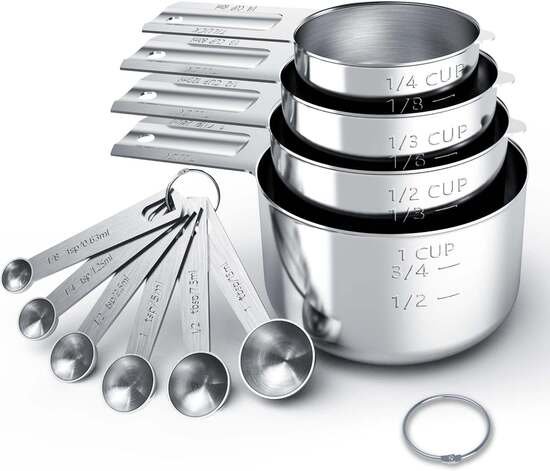
These cups are usually available in sets containing 1 cup, 1/2 cup, 1/3 cup, and 1/4 cup.
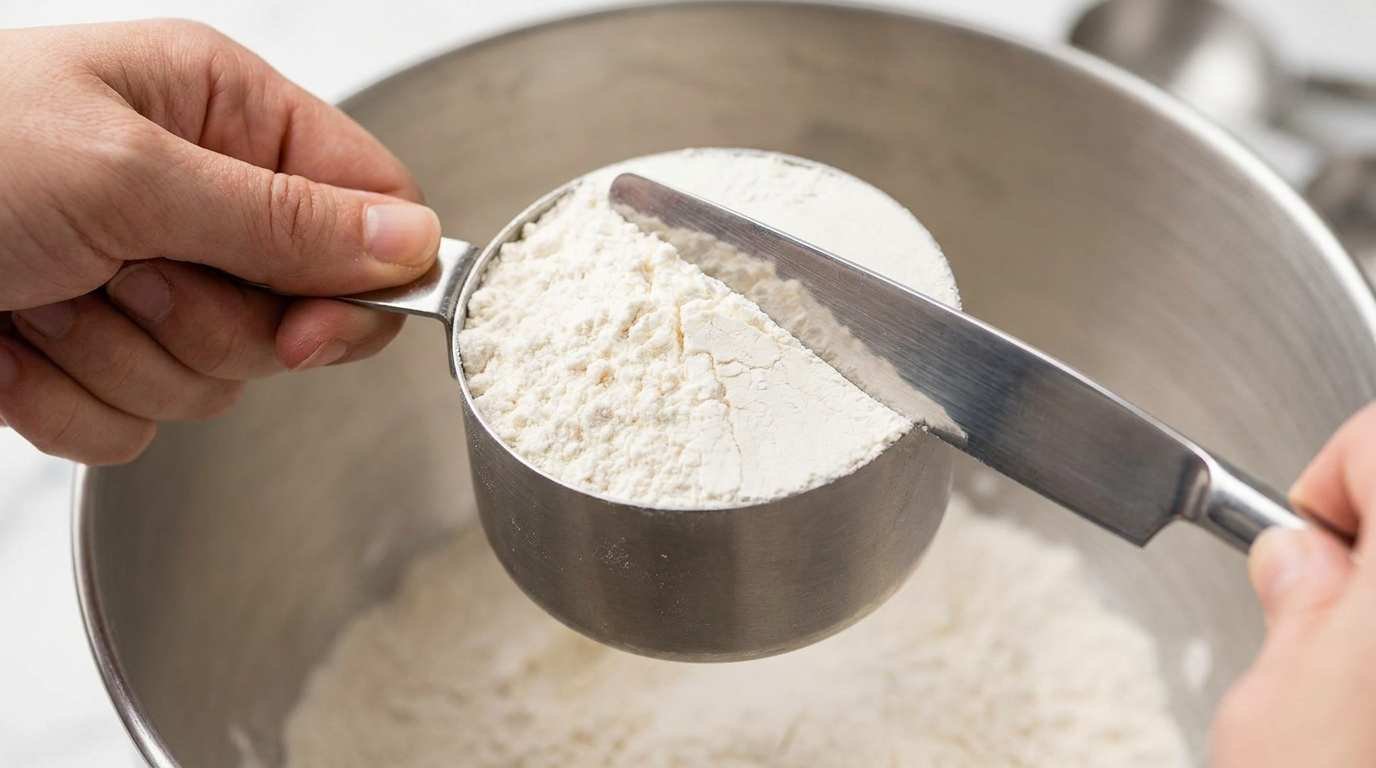
For ingredients such as flour, we should fill the cup according to the recipe’s intended method and then level the surface with a straight edge.
Liquid Measuring Cups
Liquid measuring cups typically have a spout and measurement markings on the side. They are designed for ingredients such as:
- Water
- Milk
- Cream
- Oil
- Juice
- Vinegar
- Broth
To measure liquid accurately, place the cup on a flat, level surface and pour the ingredient until it reaches the desired marking. We should check the measurement at eye level rather than holding the cup in the air.
This prevents the liquid from appearing higher or lower than it actually is.
How to Measure Flour Correctly
Flour is one of the ingredients most affected by inaccurate measuring.
If we scoop flour directly from a tightly packed container, we may end up with significantly more flour than intended. This can produce dry, heavy, or dense baked goods.
The most reliable method when using volume measurements is the spoon-and-level method.
Step-by-Step Flour Measurement
- Loosen the flour in its container using a spoon or fork.
- Spoon the flour gently into a dry measuring cup.
- Continue filling until the flour rises slightly above the rim.
- Do not pack or shake the cup.
- Use the straight edge of a knife or spatula to level the top.
- Add the measured flour to the recipe.
The goal is to create a consistent measurement without compressing the flour.
Using a Kitchen Scale for Maximum Accuracy
A digital kitchen scale is generally the most precise tool for measuring ingredients. Instead of relying on volume, we measure ingredients by weight, usually in grams.
This method is especially valuable for baking because ingredients can vary considerably in density.
For example, one person’s cup of flour may contain more flour than another person’s cup simply because one person packed it more tightly.
A scale eliminates much of this variation.
How to Use a Kitchen Scale
Place the mixing bowl on the scale and press the tare or zero button. Add the first ingredient until the desired weight appears. Press tare again before adding the next ingredient.
This allows us to measure multiple ingredients directly into one bowl without using several measuring cups.
A kitchen scale also makes recipe scaling much easier. If a recipe requires 250 grams of flour and we want to make half the recipe, we simply measure 125 grams.
How to Measure Sugar Correctly
Different types of sugar may require different techniques.
Granulated Sugar
Granulated sugar is generally straightforward to measure. We can spoon it into a dry measuring cup and level the top.
Unlike flour, it usually does not need to be loosened before measuring.
Brown Sugar
Brown sugar is commonly measured by packing it firmly into the measuring cup when the recipe specifies a packed measurement.
Fill the cup with brown sugar and press it down firmly. Continue adding sugar until the cup is full. When turned out, the brown sugar should retain the shape of the measuring cup.
If a recipe says “1 cup packed brown sugar,” we should not substitute an unpacked cup because the quantity will be different.
Powdered Sugar
Powdered sugar can become compacted during storage. We should break up large lumps before measuring and follow the recipe’s instructions regarding sifting.
If the recipe specifically calls for sifted powdered sugar, the ingredient should be sifted before measuring.
How to Measure Small Ingredients
Measuring spoons are ideal for small quantities of ingredients such as:
- Salt
- Baking powder
- Baking soda
- Vanilla extract
- Spices
- Yeast
- Lemon juice
- Cooking extracts
Use the appropriate spoon size and fill it according to the recipe.
For dry ingredients, level the spoon with a straight edge unless the recipe specifically instructs us to use a heaping measurement.
For liquid ingredients, fill the spoon carefully without allowing the liquid to overflow.
How to Measure Sticky Ingredients
Ingredients such as honey, maple syrup, molasses, peanut butter, and thick sauces can cling to measuring cups and spoons.
A simple technique is to lightly coat the measuring utensil with a small amount of neutral cooking oil when appropriate. The sticky ingredient will slide out more easily.
For maximum accuracy, we can also weigh sticky ingredients directly on a digital scale.
This is particularly convenient when preparing recipes that require several tablespoons or cups of syrup, honey, or other dense ingredients.
How to Measure Butter Correctly
Butter is usually sold with measurement markings on the wrapper, making it relatively easy to portion.
When a recipe calls for butter by tablespoons, we can use the markings on the package. If it specifies grams, we should use a kitchen scale.
When measuring softened butter by volume, we should press it firmly into the measuring cup or spoon to eliminate large air pockets.
Melted butter should be measured after melting unless the recipe specifically states otherwise.
This distinction is important because solid butter and melted butter occupy volume differently.
How to Measure Spices and Seasonings
Spices are usually measured using measuring spoons.
We should avoid dipping a wet spoon into a spice container because moisture can cause the remaining spice to clump or spoil.
For consistent results, fill the spoon and level it when the recipe calls for a level measurement.
When a recipe says “1 tablespoon salt,” we should not automatically substitute a heaping tablespoon. A heaping spoonful can contain considerably more seasoning.
Measuring Ingredients by Weight vs. Volume
There are two major approaches to measuring ingredients: volume and weight.
| Measurement Method | Best For | Accuracy |
|---|---|---|
| Kitchen scale | Flour, sugar, butter, baking ingredients | Excellent |
| Dry measuring cups | Flour, sugar, grains | Good |
| Liquid measuring cups | Water, milk, oil, broth | Good |
| Measuring spoons | Spices, extracts, small quantities | Good |
For precision-focused cooking and baking, weight is generally preferred.
Volume measurements remain practical and widely used, especially for home cooking. The key is using the appropriate tool and technique for each ingredient.
Common Ingredient Measuring Mistakes
Avoiding a few common mistakes can immediately improve recipe consistency.
Scooping Flour Directly From the Bag
Directly scooping flour can compress it and result in too much flour.
Using a Liquid Cup for Flour
Liquid measuring cups are not designed for leveling dry ingredients accurately.
Measuring Over a Bowl
Measuring ingredients directly over a mixing bowl can make it difficult to see the measurement and increases the chance of adding too much.
Reading Liquid Measurements From Above
Always check liquid measurements at eye level.
Ignoring Recipe Instructions
Terms such as packed, sifted, leveled, melted, softened, chopped, and sliced can affect the actual quantity of an ingredient.
Understanding “1 Cup Chopped” vs. “1 Cup, Chopped”
Recipe wording can sometimes make measurements confusing.
“1 cup chopped onions” generally means we chop the onions first and then measure one cup.
“1 cup onions, chopped” generally means we measure the onions first and then chop them.
For ingredients whose size changes considerably when chopped, this distinction can affect the final quantity.
When a recipe provides a weight measurement, however, following the weight is usually the clearest approach.
How to Measure Ingredients Correctly Without Making a Mess
Good measuring technique is not only about accuracy. It can also make preparation faster and cleaner.
We can organize ingredients before starting, keep measuring spoons together, and place a small bowl nearby for transferring measured ingredients.
For recipes containing numerous dry ingredients, we can measure them into individual containers before cooking. For simpler recipes, a digital scale allows several ingredients to be measured directly into the mixing bowl.
Keeping the work surface level and dry also helps prevent measuring errors.
How to Measure Ingredients for Baking
Baking requires particular attention to measurement because ratios strongly influence the final structure.
Before beginning, we should read the entire recipe and identify which ingredients are measured by weight and which are measured by volume.
If a recipe provides measurements in grams, it is best to use grams rather than converting everything into cups.
For flour, cocoa powder, powdered sugar, and other light ingredients, weighing is especially useful.
Liquids should also be measured carefully. When a recipe provides both volume and weight measurements, the specified weight should generally take priority.
Tips for Consistent Recipe Results
For reliable results, we can follow a simple measurement routine:
- Read the recipe completely before measuring.
- Gather all ingredients and measuring tools.
- Use a kitchen scale when weight measurements are provided.
- Use dry measuring cups for dry volume measurements.
- Use liquid measuring cups for liquids.
- Level dry ingredients when instructed.
- Pack brown sugar when specifically required.
- Check liquid measurements at eye level.
- Pay attention to words such as “sifted” and “packed.”
- Measure ingredients before adding them to the recipe.
Consistency is more important than complexity. Once these habits become automatic, accurate measurement becomes a natural part of cooking.
Final Thoughts
Knowing how to measure ingredients correctly is a fundamental kitchen skill that can make recipes more predictable and repeatable. The right measuring technique depends on the ingredient, the recipe, and whether the measurement is given by volume or weight.
For everyday cooking, properly using measuring cups and spoons is often sufficient. For baking and precision recipes, a digital kitchen scale offers an additional level of accuracy.
By measuring flour with care, packing brown sugar when required, checking liquids at eye level, and following recipe-specific instructions, we can achieve much more consistent results. Small improvements in measurement technique can make a noticeable difference in everything from fluffy cakes and tender cookies to perfectly balanced sauces and well-seasoned meals.




Leave a Reply