


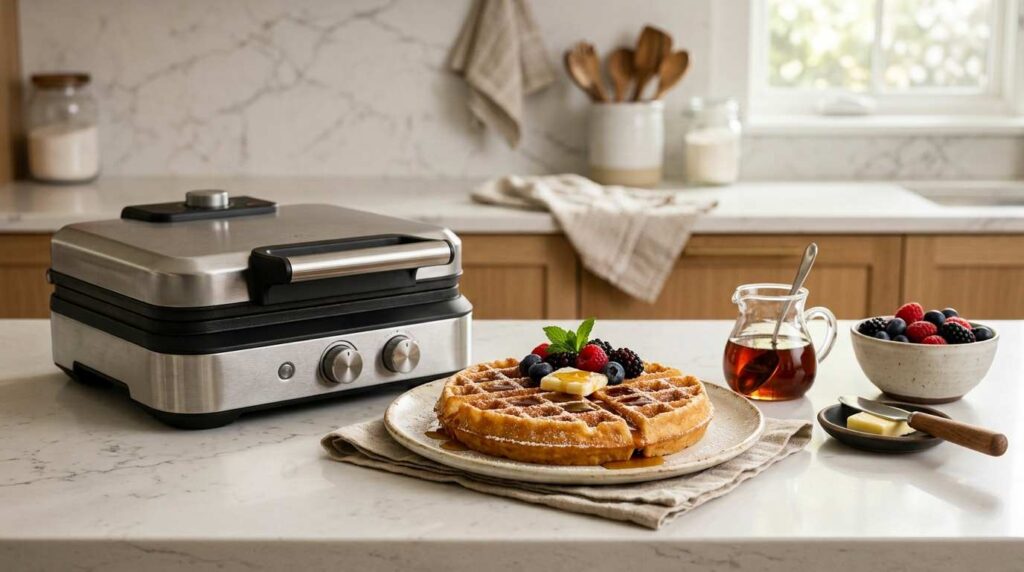
A good Belgian waffle iron can turn a simple breakfast into something worth looking forward to. The best models produce thick, crisp-edged waffles with a light, airy center, while also making the cooking process easy enough for everyday use.
With so many waffle makers available, however, choosing one is not simply a matter of picking the appliance with the highest wattage or the most attractive design. Heat distribution, plate depth, temperature control, cleanup, cooking speed, storage, and consistency all matter.
These Belgian waffle iron reviews focus on the features that make the biggest difference in real kitchen use, whether we are preparing weekend breakfasts for the family or making waffles regularly throughout the week.
Table of Contents
What Makes a Belgian Waffle Different?
Belgian waffles are generally thicker and deeper than traditional American-style waffles. Their characteristic pockets hold butter, maple syrup, fruit, whipped cream, chocolate sauce, and other toppings particularly well.
The waffle iron therefore needs deep cooking plates capable of producing the proper texture.
A quality Belgian waffle maker should create enough heat to brown the exterior without drying out the interior. Ideally, we want a waffle that is golden and crisp outside while remaining soft and airy inside.
The depth of the plates also affects how much batter we can use. A shallow iron may produce something closer to a standard waffle, even when the appliance is marketed as a Belgian waffle maker.
Key Features to Look for in Belgian Waffle Iron Reviews
When comparing waffle makers, we should look beyond appearance and advertised features. Several practical specifications have a direct effect on the finished waffle.
Deep Belgian-Style Plates
Deep grids are one of the most important features.
A proper Belgian waffle iron should have sufficiently deep pockets to create the thick texture associated with Belgian-style waffles. Deeper plates also give toppings more room to settle into the waffle.
If the plates are too shallow, the result can look more like an ordinary breakfast waffle.
Even Heat Distribution
Heat distribution is critical.
If one section of the cooking surface becomes hotter than another, we can end up with waffles that are dark around the edges but pale in the center. Uneven heating can also make one side cook faster than the other.
A well-designed appliance should distribute heat consistently across the cooking plates.
This is particularly important when making several waffles in succession. The best waffle makers maintain relatively consistent cooking performance instead of producing excellent results on the first waffle and inconsistent results afterward.
Adjustable Temperature Control
A temperature dial or electronic control gives us more flexibility.
Different recipes can require different heat levels. A batter containing more sugar, for example, may brown more quickly than a less sweet recipe.
Adjustable temperature settings allow us to find the right balance between crispness, color, and interior texture.
For households that experiment with different waffle recipes, adjustable heat is especially useful.
Indicator Lights and Audible Alerts
Simple controls can make a surprisingly big difference.
Indicator lights can tell us when the appliance has reached cooking temperature and when the waffle may be ready. Some models also provide an audible signal.
These features are useful because we do not have to keep lifting the lid to check whether the waffle is cooked.
Avoiding unnecessary lid opening also helps maintain the heat inside the cooking chamber.
Belgian Waffle Iron Size Matters
Counter space is easy to overlook when choosing a waffle maker.
A large Belgian waffle iron may produce impressive waffles, but it can become inconvenient if we have limited kitchen storage.
Before buying, we should consider:
- Countertop width
- Storage cabinet space
- Cord storage
- Overall appliance weight
- Plate size
- Whether the unit can be stored vertically
A compact model may be more practical for a small kitchen, while a larger appliance can make sense for families that regularly prepare multiple waffles.
Single Waffle vs. Multiple Waffles
One of the most useful differences between waffle makers is how many waffles they can produce at once.
A single-waffle appliance is usually easier to store and may be ideal for one or two people.
For larger households, a double Belgian waffle maker can significantly reduce breakfast preparation time. Instead of waiting for one waffle to finish before starting another, we can cook multiple portions during the same cycle.
This becomes particularly valuable when serving several people at once.
Removable Plates vs. Fixed Plates
Cleanup is one of the biggest practical considerations in any waffle maker.
Some appliances feature removable cooking plates that can be taken out for washing. Others use permanently attached plates that must be cleaned in place.
Removable plates can make cleanup easier, especially when batter spills over the edges.
However, fixed plates are not necessarily a problem if they have a good nonstick surface and can be wiped clean easily.
Regardless of design, we should avoid abrasive cleaning tools that could damage the cooking surface.
Nonstick Cooking Surfaces
A reliable nonstick surface helps prevent waffles from sticking and makes cleanup easier.
It also allows us to use less oil or butter when preparing waffles.
A good nonstick surface should release the waffle without requiring excessive scraping. This is particularly important with delicate recipes containing ingredients such as fruit, chocolate, or additional sugar.
Even with nonstick plates, lightly greasing the surface can sometimes help, depending on the recipe and the manufacturer’s instructions.
How Much Power Does a Belgian Waffle Iron Need?
Wattage is worth considering, but it should not be the only factor.
A higher wattage can help an appliance heat quickly and recover temperature between batches. However, wattage alone does not guarantee better waffles.
Heat distribution and temperature control are equally important.
A well-designed waffle maker with efficient heating can outperform a higher-powered appliance with poor heat distribution.
For regular home use, we should consider the complete heating system rather than selecting a model solely because it has a large wattage number.
How to Get Crisp Belgian Waffles
Even the best waffle iron cannot compensate for poorly prepared batter.
For crisp Belgian waffles, we should pay attention to both the recipe and cooking process.
A few practical techniques can help:
- Preheat the waffle maker completely before adding batter.
- Avoid opening the lid repeatedly during cooking.
- Do not overfill the plates.
- Allow excess steam to escape naturally.
- Place finished waffles on a wire rack rather than stacking them immediately.
- Adjust the temperature if waffles are browning too quickly.
- Use a batter recipe designed for thick Belgian-style waffles.
Putting hot waffles directly on a plate can trap steam underneath them. That steam can soften the crisp exterior.
A wire rack allows air to circulate around the finished waffle and helps preserve its texture.
Belgian Waffle Iron Reviews for Families
Families generally benefit from a waffle maker that prioritizes speed, capacity, durability, and easy cleanup.
A double waffle maker can be particularly useful because everyone does not have to wait as long for breakfast.
A strong handle and sturdy hinges are also worthwhile features for frequent use. Lightweight plastic construction may be acceptable for occasional use, but frequent cooking can justify choosing a more substantial appliance.
Controls should be straightforward enough that anyone in the household can use the waffle maker without consulting complicated instructions.
Belgian Waffle Makers for Small Kitchens
For apartments, compact kitchens, and smaller households, storage deserves as much attention as cooking performance.
A compact waffle maker that can be stored vertically may be more useful than a larger model with additional features that rarely get used.
We should measure the available storage area before buying.
It is also worth checking whether the cord can be wrapped or stored neatly. A waffle maker that takes only a few minutes to use but is difficult to store may become an appliance that stays hidden in a cabinet.
Cleaning a Belgian Waffle Maker
The easiest waffle maker to live with is usually the one that can be cleaned quickly.
After cooking, we should allow the appliance to cool before cleaning it. Loose crumbs can generally be brushed away, while residue can be removed with a soft, damp cloth.
If the manufacturer permits removable plates to be washed separately, that can simplify the process.
We should avoid immersing an electrical appliance in water unless the manufacturer specifically states that it is designed for this.
Cleaning immediately after the appliance cools can also prevent batter residue from becoming stubborn.
What About Rotating Belgian Waffle Makers?
Some Belgian waffle makers use a rotating mechanism that allows the cooking chamber to turn after batter is added.
The purpose is to help distribute the batter more evenly throughout the deep waffle grid.
This design can be useful for thick waffles because Belgian-style batter needs to spread across deeper pockets.
A rotating mechanism does, however, add another moving component to the appliance. We should therefore consider whether the feature provides meaningful value for our cooking habits.
Common Mistakes When Buying a Belgian Waffle Iron
Several mistakes are easy to avoid.
Choosing Based Only on Price
The cheapest waffle maker may appear attractive initially, but durability, heat consistency, and cleanup can matter more over years of use.
At the same time, the most expensive model is not automatically the best choice for every kitchen.
Ignoring Plate Depth
If thick Belgian waffles are the goal, plate depth should be one of the first specifications we check.
Overlooking Storage
A large appliance can quickly become inconvenient in a small kitchen.
Buying Too Many Features
Digital displays, multiple cooking programs, rotating systems, and specialty settings can be useful, but only if we actually use them.
Simple controls can be preferable for people who mainly want consistently good waffles.
What Should We Prioritize?
When comparing Belgian waffle irons, we can simplify the decision by focusing on a few essential characteristics:
| Feature | Why It Matters |
|---|---|
| Deep plates | Creates thick Belgian-style waffles |
| Even heating | Helps prevent uneven browning |
| Temperature control | Allows greater cooking flexibility |
| Nonstick surface | Helps with release and cleanup |
| Multiple waffle capacity | Speeds up family breakfasts |
| Removable plates | Can simplify cleaning |
| Compact design | Useful for smaller kitchens |
| Durable construction | Better suited to frequent use |
| Indicator lights | Makes operation easier |
| Rotating design | Can improve batter distribution |
Final Thoughts on Belgian Waffle Iron Reviews
The right Belgian waffle maker should match the way we actually cook.
For occasional weekend breakfasts, a straightforward model with deep plates, reliable heating, a good nonstick surface, and simple controls may provide everything we need.
For larger households, capacity and cooking speed become more important. For small kitchens, compact storage may take priority. For frequent waffle makers, durability, temperature control, and easy cleaning can make a significant difference over time.
The goal is not simply to find a waffle iron with the longest feature list. It is to choose an appliance that consistently produces the thick, golden, crisp Belgian waffles we want while fitting naturally into our kitchen routine.
When comparing Belgian waffle iron reviews, we should therefore evaluate the complete experience—from preheating and batter distribution to cooking, serving, cleaning, and storage. That approach makes it easier to find a waffle maker that remains useful long after the novelty of buying a new kitchen tools has disappeared.